
A field report for investigators on the lagoon island that folklore turned into a legend, and history left quietly empty.
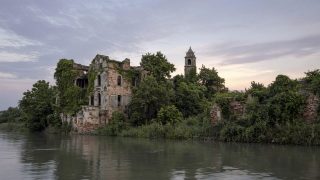
There are haunted places that shout. Poveglia does not. From the water it looks almost ordinary: a low green smudge between Venice and the Lido, a bell tower rising from trees, brick walls the colour of old terracotta. The lagoon around it is bright and working — ferries, fishing boats, the ordinary traffic of a city that never stopped. Then you notice there is no landing stage open to the public, no path you are meant to follow, and the island sits there with its back turned, overgrown and closed. The unease is not theatrical. It is the feeling of looking at a place that once had a job and has not been given another.
An Island With a Job, Then None
Poveglia lies in the Venetian Lagoon south of the historic city, near the Malamocco channel that leads in from the Adriatic. In the Middle Ages it was a real settlement: houses, local government, a community with privileges under the Republic of Venice. That life ended for strategic reasons rather than supernatural ones. During the War of Chioggia in the late fourteenth century the population was evacuated so the island could serve as a military outpost. The original inhabitants did not return in force. For centuries afterwards Poveglia remained thinly occupied or empty.
In 1782 the Magistrato alla Sanità of Venice took the island into the sanitary system. After the older quarantine islands of Lazzaretto Vecchio and Lazzaretto Nuovo, Poveglia became the “newest” lazaretto — a maritime quarantine and disinfection station for ships, crews and cargo entering the lagoon. Temporary plague use is documented at the end of the eighteenth century when cases appeared on arriving vessels; the island’s longer working life was as a contumacy station and later as part of the Italian maritime health apparatus. In the nineteenth century the church of San Vitale was demolished under Napoleonic measures and its bell tower was rebuilt and used as a lighthouse. That tower is still the silhouette people recognise from the water.
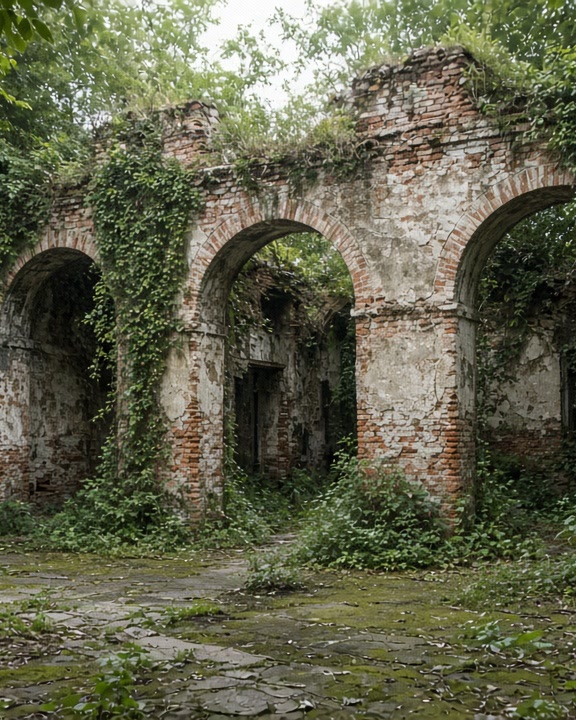
In the twentieth century the existing buildings were converted into a long-term care facility, commonly described as a geriatric sanatorium, with limited psychiatric capacity in a dedicated wing. The hospital closed around the late 1960s. After a short period of caretaker use, the island was left empty. What photographers see now — ruined wards, courtyards taken by plants, windows without glass — is abandonment after institutional closure, not a stage set built for horror.
For investigators the physical layout matters. Poveglia is small, divided into sections including a defensive octagon, and approachable only by water. There is no public ferry stop. Buildings hold damp, echo, and the usual hazards of derelict masonry. Fog and lagoon light change the reading of every surface. Your camera and recorder will work; your sense of permission will not. That is not a paranormal claim. It is the island’s present legal and practical condition.
What Folklore Built on Top
Venetian ghost belief mixes Catholic ideas of the restless dead, popular stories about plague and bad deaths, and the modern language of haunted asylums imported from elsewhere. Poveglia sits at the junction of all three.
The oldest layer people attach to the island is plague. Venice did invent and refine quarantine islands; the word “quarantine” itself comes from the forty-day waiting period. Lazzaretto Vecchio, not Poveglia, carried the heaviest documented burden as a plague hospital for the sick. Poveglia’s documented plague episodes were real but more limited — emergency use when infection arrived by ship. Folklore has a habit of collapsing every sanitary island into one mass of unmarked graves. On Poveglia that collapse is part of why the place feels heavier than its archival record alone would suggest.
The second layer is the hospital. Abandoned medical buildings attract a global template: cruel doctors, tortured patients, screaming in empty corridors. Serious local history writing describes Poveglia’s twentieth-century use as geriatric and long-term care, with psychiatric beds only in a small wing — not a notorious penal asylum. That distinction rarely survives in online retellings. The buildings look the part of the legend, so the legend sticks.
The third layer is modern media. Paranormal television, travel writing and online videos have repeatedly ranked Poveglia among the most haunted places on Earth. Once a location enters that circuit, new visitors arrive already primed. The island becomes famous for being famous for haunting. Investigators who skip that feedback loop will misread every cold spot.
Case Accounts
What follows is representative of reports that circulate among boaters, photographers, documentary crews, and the large body of second-hand testimony. Treat them as testimony, not as evidence. Where a natural explanation exists I have named it.
The watched feeling from the water. Near-universal among people who circle the island without landing. Witnesses describe a certainty of being observed from the trees or the tower windows. Natural candidates: the human tendency to read faces into empty openings, plus the knowledge that you are looking at a place you are not supposed to enter. Anticipation does half the work before you leave the boat.
Voices in the courtyards. Reported by those who have gone ashore: indistinct speech, sometimes a call, sometimes conversation just out of sight. Derelict brick rooms around a shared courtyard create acoustic pockets. Wind off the lagoon finds gaps in roofing and doors. Distant boat engines and voices carry oddly over water and can arrive with no clear source.
Footsteps on upper floors. The pattern is familiar from other abandoned hospitals: steps overhead when the witness is alone downstairs, or a door that closes a beat after they pass. Timber floors settle. Birds and rodents move. Temperature differences between sunlit and shadowed rooms drive air through corridors. None of that rules out something stranger; none of it requires something stranger either.
Lights in the tower. Pale lights reported at dusk in or near the former campanile. The tower once functioned as a lighthouse structure; surrounding lagoon traffic carries navigation lights; reflections from wet brick and glass at low sun are easy to misread. After dark, any unauthorised visitor with a torch becomes someone else’s anomaly.
The soil and the bones. A persistent claim holds that a large fraction of the island’s soil is composed of human remains from plague burials. Historians and lagoon researchers have pushed back hard on the most extreme versions, pointing to better-documented burial and lazaretto sites elsewhere in the lagoon. Investigators should record the claim as folklore until they have primary archaeological or archival evidence in hand. Do not dig. Do not disturb anything that looks like a grave or a medical deposit.
The doctor who went mad. A widely repeated tale describes a physician at the hospital who performed cruel experiments and then met a violent end on the island. I have found no solid documentary trail for the most dramatic versions of this story in publicly available historical writing; it behaves like a floating asylum legend that attached itself here because the buildings fit. Note it in your file as unverified narrative, not as case fact.
Equipment failure. Cameras that drain, recorders that catch static, compasses that wander. Salt air, damp, metal structures and the simple fact that consumer electronics dislike cold wet ruins explain most of it. Log battery levels and ambient humidity on arrival so you are not inventing a mystery out of a flat cell.
The media era. Once international paranormal programmes and online creators labelled Poveglia among the world’s most haunted islands, access stories multiplied: secret landings, overnight challenges, drone footage of courtyards. Local communities and authorities have good reasons to resent that traffic. Whatever you publish becomes part of the pressure on a fragile, closed site. Write accordingly.
Studies, Access, and Things That Went Wrong
Poveglia is Italian state property and is not a tourist attraction. Landing without authorisation is trespass. That is the first and most important investigative fact, and it is not supernatural.
Academic attention has begun to treat the island’s ghost reputation as a cultural object in its own right — how narratives form around an abandoned place in a famous lagoon, how global haunted-place lists overwrite local history. That research is useful because it predicts contamination: witnesses who have already watched the programmes will tend to report the phenomena the programmes taught them to expect.
Things that go wrong here are usually ordinary and serious. Unstable floors and roofs. Open wells and drop-offs. Getting stranded when weather turns. Legal trouble if you land without permission. The folklore has also been used to sell overnight “challenges” that put people into buildings they cannot safely exit. An investigator who encourages that is not investigating. They are contributing to the problem.
Hoaxes are easy on an island almost nobody can check. A photograph of a misty corridor travels farther than a correction about geriatric wards. Keep your own bar for evidence high precisely because the internet’s bar is on the floor.
If You Are Going
Most investigators should not go ashore. The honest field protocol for Poveglia starts with that sentence.
Practical protocol:
- Prefer water-level observation from a licensed boat tour or hired skipper who stays legal. Photograph the silhouette, the tower, the tree line. Note sound, light and your own physiological baseline from a place you are allowed to be.
- Do not land without clear written authorisation from the competent authority. “Everyone does it” is not a method.
- If you somehow hold legitimate access for research or conservation work: hard hats, sturdy boots, no solo entry into upper floors, surface contact on the mainland who knows your out-time.
- Two navigation and communication systems. Lagoon fog and phone coverage are not your friends.
- Log ambient temperature, humidity and sound levels before you decide anything is anomalous. Salt air and ruin acoustics are the baseline.
- Do not remove objects, dig, open sealed rooms for sport, or stage evidence for an online video. Leave the site as you found it, or better.
- If you encounter other people ashore, assume they may be in distress or trespassing. Your job is not to film them. Contact emergency services if someone needs help.
- Whatever you publish, distinguish archival history from folklore. The island has suffered enough from the opposite habit.
What It Actually Is
Poveglia is a small lagoon island that was once a medieval community, then a military outpost, then a quarantine and maritime health station, then a hospital for the elderly and the chronically ill, and then empty. The bell tower that watches the Malamocco channel is a lighthouse converted from a church campanile. The courtyards are institutional architecture losing a fight with plants. The plague story belongs partly here and partly to other, better-documented islands nearby. The asylum horror story belongs mostly to a global template that found a photogenic ruin.
It is also a place where real people spent the end of their lives in isolation from the city across the water, and where Venetian public health once tried — imperfectly, humanly — to keep contagion from entering the basin of San Marco. The ghosts may or may not be there. The abandonment is definitely there, and so is the weight of a working past that tourism prefers to rewrite as pure nightmare.
An investigator who can hold both truths at once — the documented sanitary history and the reported chill in the courtyard — is already doing better work than another ranking list. Poveglia does not need you to make it darker. It needs you to see it clearly from the boat, leave it closed if it is closed, and refuse to confuse a legend with a case file.
Leave a Reply