
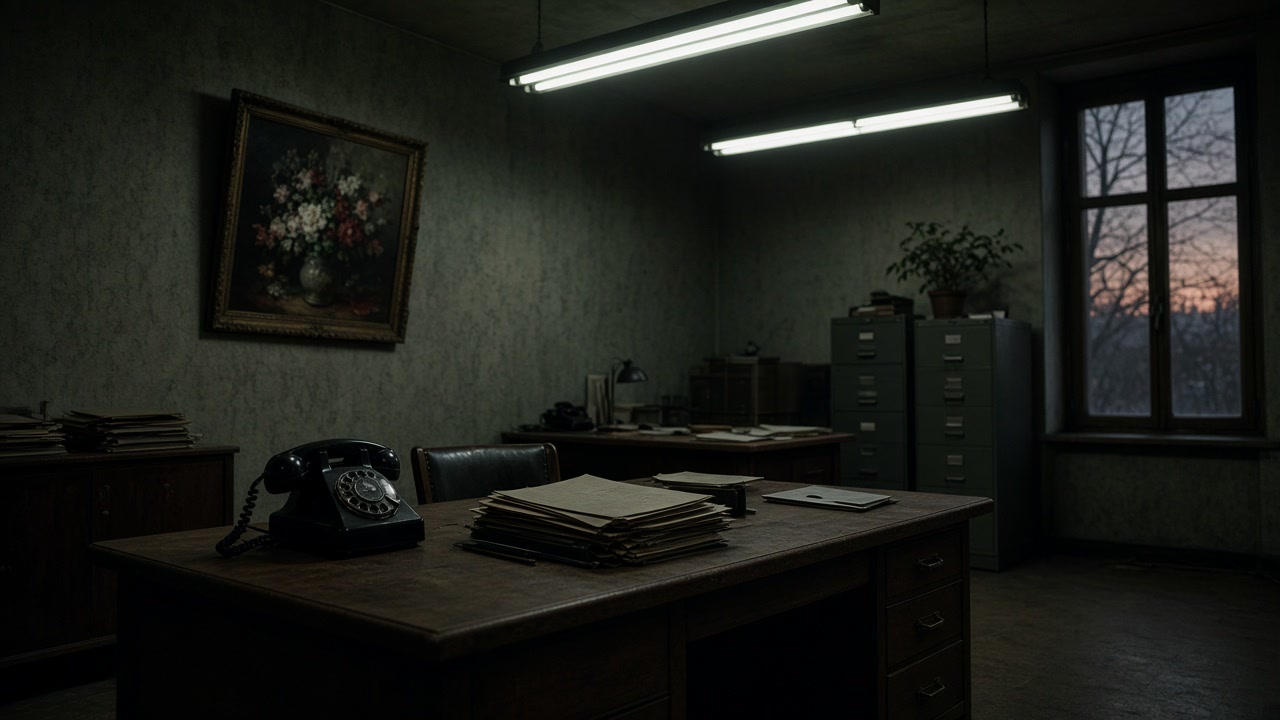
A field report on one of Europe’s most instrumented hauntings: the phones, the lights, the moving furniture, and the questions nobody has answered since 1967.
Haunted houses usually arrive with a reputation. This one arrived with a telephone bill. In the summer of 1967, in a quiet Bavarian town southeast of Munich, a working law office began to fail in ways that first looked like bad wiring and bad luck. Phones cut out mid-conversation. Ceiling fixtures went dark for no reason the electricians could name. Nobody was whispering about ghosts. They were calling the telephone authority and the municipal power board, because that is what sensible people do when equipment stops behaving.
The Setting Was Ordinary on Purpose
Rosenheim sits on the Inn River in Upper Bavaria — a provincial centre, not a tourist ruin. The events of late 1967 unfolded inside a solicitor’s practice in the town centre: four telephone lines, fluorescent lighting, a photocopier, filing furniture, clerks, clients, the ordinary traffic of a working week. There was no cemetery under the floorboards and no legend attached to the building beforehand. That matters. Investigators who only study places already branded as haunted are studying expectation as much as anomaly. Rosenheim began as an engineering complaint.
The chronology, as reported across contemporary press, utility records and later case summaries, runs roughly from summer into early winter. Dead lines and cut calls came first. Then the speaking-clock number — the automated time service then dialled as 0119 in Germany — began appearing on the firm’s bill in volumes the staff denied placing. Fluorescent tubes at roughly two and a half metres up were found twisted ninety degrees in their fittings. Circuit breakers tripped. Bulbs shattered. A photocopier leaked developer fluid. Pictures on walls were later said to rotate on their hooks. Drawers opened. A heavy oak storage unit was reported to have shifted centimetres across the floor in front of witnesses. Roughly forty people, including police, technicians, medical observers and clients, are cited in the German record as having seen one or more of the disturbances.
What makes that list extraordinary is not only what happened but who saw it. Several categories of observer with no interest in paranormal fame — utility staff, telecommunications engineers, criminal police — were drawn in before any academic paranormal institute arrived.
Engineers First, Parapsychologists Later
This is the detail that separates Rosenheim from most poltergeist folklore. The firm’s first response was not a séance. It was the post and telephone authority, then the technical inspection office of the municipal utilities. Recording equipment was placed on the lines. A charge meter was installed on site. Telephones were later locked so that only the principal held the keys — and the speaking-clock calls were still logged in startling numbers, including reports of dozens of attempts within a quarter of an hour, and, later that autumn, hundreds of such calls in a single month. The municipal team sealed measuring instruments, logged current spikes concurrent with bangs and failures, and even arranged a direct feed from the transformer station to rule out ordinary grid fluctuation. Short circuits and meter faults were, in their own account, excluded.
Then physical events escalated in front of the same technicians: wall plates jumping, lamps swinging, drawers moving, fluid from the copier. One utility inspector later described standing near a flower painting when it spun rapidly on its hook — far enough, he wrote, that he was certain no hand in the room had turned it. That was roughly the point at which conventional troubleshooting was declared exhausted and the case left the world of blown fuses for the world of published controversy.
Only after that sequence did a Freiburg institute devoted to borderline psychology enter, led by a well-known German investigator of spontaneous psychokinesis claims. Two physicists — one associated with a major plasma-physics institute, another with a Munich technical university — instrumented the office with voltage and current recorders, oscilloscopes, microphones, magnetometers and temperature sensors. Television cameras filmed. The investigation that followed is why Rosenheim still appears in both parapsychology and sceptical literature half a century later. It was not a weekend ghost hunt with a borrowed meter.
Case Accounts
What follows is representative of the reported phenomena, drawn from the public case literature and the accounts of the people who were in the room.
The speaking-clock avalanche. The most stubborn technical claim. Outgoing calls to the time service were logged in volumes the staff denied, at rates that ordinary hand-dialling on the era’s electromechanical equipment struggled to explain. The telephone authority put its own recording equipment and charge meter on the lines. Then the phones were locked, and the calls kept coming. Nobody has ever shown who, or what, was dialling.
Twisted tubes and bursting bulbs. Fluorescent tubes found rotated in high fittings; replacements repeating the twist under observation; later, filament bulbs exploding — in one account injuring a clerk, after which nylon nets were hung under the fittings and more bulbs still failed. The fittings hung well out of reach, and technicians were standing in the office during some of the failures.
Voltage spikes without a found short. Sealed municipal recorders logged large current deflections timed with bangs and light failures, after ordinary wiring faults were reportedly ruled out and a cleaner supply feed installed. Physicists later wrote that unexplained deflections remained after they had systematically checked the causes they could invent. Technicians who measured electricity for a living looked at their own sealed charts and could not say where the power had come from.
Swinging lamps and rotating pictures. Ceiling fittings swinging without draught; a framed picture rotating on its hook, including the much-cited utility inspector’s account and film of similar motion. The inspector who watched the painting turn was a practical technician sent to find a fault, and wrote that no hand in the room had touched it.
Moving furniture and opening drawers. Desk drawers opening; a heavy oak cupboard reported shifted about thirty centimetres while scientists watched. A cupboard that heavy does not wander across a floor on its own.
The focus person. Investigators noticed early that disturbances clustered during office hours and around the presence of a nineteen-year-old trainee clerk. When she was sent away, reports say activity stopped; when she returned, it resumed; when she left the firm in January 1968, the office quieted. Parapsychologists called this recurrent spontaneous psychokinesis centred on a conflicted young “focus person.” The clerk herself later denied having any special powers, and she never asked for any of it. Whatever was in that office seemed to be drawn to her, and it left when she did.
What Was Never Explained
When a case becomes famous, doubters arrive. Years later, some stage magicians and reviewers claimed to have found props on the premises and argued that parts of the story were staged. The people who had actually been there answered that a prop behind a cupboard does not dial a locked telephone, does not move a needle on a sealed municipal recorder, and does not spin a painting in front of the inspector sent to find the fault. Nobody who tried to explain Rosenheim away ever managed to explain all of it.
The physicists who studied the office were careful, and they said only what they could stand behind. After checking every cause they could think of, they wrote that something measurable had happened in those rooms that they could not account for. For scientists, that is a remarkable thing to put on paper.
So the core of the file still stands. Calls were logged that no finger dialled. Current surged through lines where no fault was found. Objects moved while trained witnesses watched. And all of it seemed to follow one young woman, then stopped when she walked out of the door for the last time.
Lessons for Investigators
Rosenheim is one of the best examples of how to document a haunting properly.
- Rule out the ordinary first. The engineers checked every line, meter and fuse, and that is exactly why the case still carries weight. The strongest paranormal cases are the ones that survive that order of work.
- Seal and log. A sealed recorder with an unexplained spike is far harder to wave away than a story told afterwards.
- Track who is in the room. If activity rises and falls with one person’s presence, write it down carefully, date by date.
- Collect witnesses from outside the circle. Technicians, police and visitors with nothing to gain gave Rosenheim its credibility.
- Record the media date. Once reporters arrive, note it, so later readers can tell early testimony from later retellings.
- Protect the people. The person at the centre of a case like this is often young and frightened. Treat them with more care than the press did in 1967.
- Write only what you can defend. Never invent a reading, a call count or a quotation. The real record is strange enough.
A File Still Open
More than half a century later, Rosenheim remains what it was in the winter of 1967: a working office where the telephones, the lights and the furniture stopped obeying the rules, in front of engineers, police and physicists who had every reason to find a simple answer and never did.
The clerk moved away and the office went quiet. The instruments were packed up, the reporters left, and the town went back to ordinary business. The question did not go anywhere. What was dialling those numbers? What pushed the current through the lines? What turned the painting on the wall while an inspector stood beside it and watched?
Nobody has answered. The file is still open, and perhaps it is meant to stay that way.
Leave a Reply