
A field report for investigators, and a warning about what the forest does to people who take it lightly.
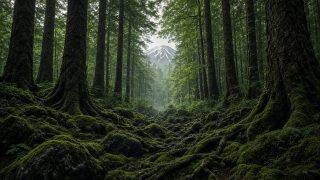
There are haunted places that announce themselves. Crumbling asylums, empty hotels, churches with the roofs gone. Aokigahara does the opposite. It is beautiful. Moss the colour of jade, hemlock and cypress in close ranks, light coming down green and slow. The unease arrives about four minutes in, when you notice you can no longer hear the road.
The Ground Itself Is Wrong
The forest lies on the northwest flank of Mount Fuji, in Yamanashi Prefecture, about 100 kilometres from Tokyo. It covers roughly 30 square kilometres. In 864 CE Fuji split open along its northern side and buried a large lake under basaltic lava, leaving behind the three lakes that now border the forest and a floor of black, porous rock.
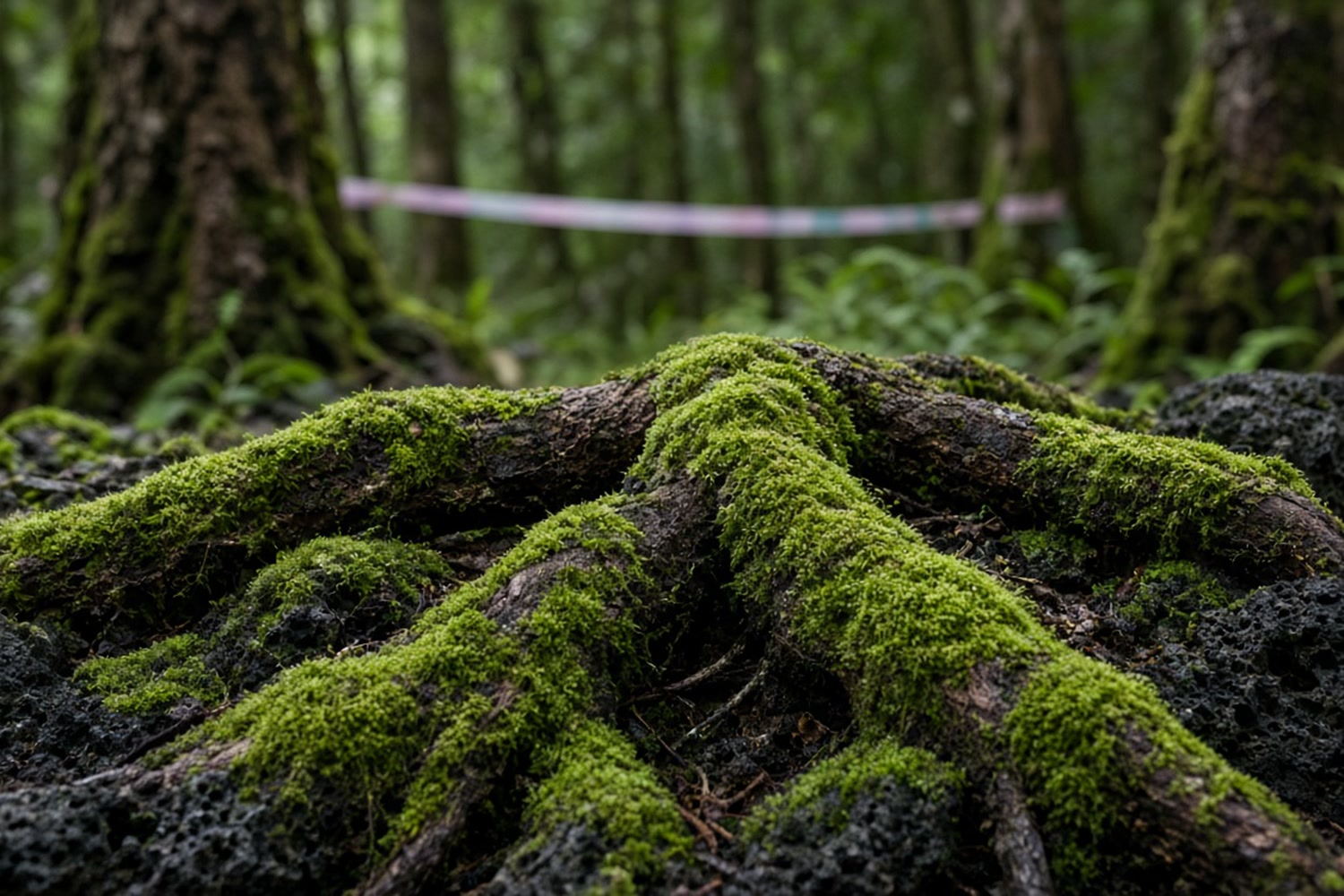
Trees came back, but they could not sink roots. They spread them sideways across the stone instead. Step off the trail and you are walking on a woven mat of exposed roots and hollow lava, and the sound your boots make is not the sound ground makes. The rock swallows noise. Wind that is audible at the treeline dies to nothing a hundred metres in. Below you, undocumented lava tubes run through the substrate, some of them large enough to stand in.
For investigators this matters for a practical reason. Ambient sound levels inside Aokigahara are genuinely abnormal, which means your audio recorder is operating in conditions it was never calibrated for, and your ears are working overtime looking for signal in silence. Bear that in mind when you review your files.
The Dead Who Cannot Leave
Japanese ghost belief gives Aokigahara its oldest layer. Yūrei are the spirits of people who died with something unfinished: grief, fury, or an attachment strong enough to hold them. They are not the theatrical ghosts of Western tradition. They appear in white burial dress, hair loose and black, hands hanging limp from the wrists, and they are bound to the place of their death rather than roaming freely.
The condition that produces a yūrei is a death without proper rites. Aokigahara has held a very large number of deaths that went unfound for months, sometimes years, and therefore unmourned in the way tradition requires. Whatever you believe, the folklore fits the site with uncomfortable precision.
The second layer is ubasute, the practice of carrying an aged relative into the mountains during famine and leaving them. Historians argue about how real this was and how much belongs to literature, and the strongest documented associations are with Mount Obasute in Nagano rather than with Aokigahara. But the story has attached itself here, and the image it carries, the abandoned elder alone under the trees, is now part of what people report sensing.
Case Accounts
What follows is representative of the reports that circulate, drawn from journalists’ interviews with local guides and officials, from documentary crews, and from the large body of visitor testimony. Treat them as testimony, not as evidence. Where a natural explanation exists I have named it, because an investigator who ignores the obvious one has already lost the case.
The voices in the inner stands. The most persistent report. Guides and prefectural workers have told interviewers that the deeper forest produces voices, generally described as indistinct conversation rather than words, sometimes as a single voice calling. Volunteers on search sweeps have reported stopping the whole line to listen. Natural candidates: the lava substrate creates strange acoustic pockets, and search teams working a grid are frequently within earshot of each other without realising it.
Following footsteps. Reported almost exclusively off-trail. The pattern is always the same, which is itself interesting: steps behind the witness, matching pace, stopping a beat after the witness stops. Hollow lava under a root mat does return delayed sound from your own footfalls. It does this more convincingly than most people expect.
The watched feeling. Near-universal. Visitors describe a weight on the chest and a certainty of being observed from a specific direction. Local guides have used the word “heavy” to journalists rather than “evil,” and that distinction recurs often enough to be worth noting in your own field notes.
Lights among the trunks. Reported at dusk and after dark, usually as small, low, pale lights that move laterally. Aokigahara has no light pollution to speak of and considerable bioluminescent fungal activity in the damp season. It also has search teams with torches and, unfortunately, other people who came in with no intention of coming out.
The tape. Every visitor sees it. Coloured plastic tape running from tree to tree, deep into the interior. It is widely misreported as something macabre. Most of it is left by ecologists, cavers mapping lava tubes, search teams marking cleared ground, and hikers who want a route back. The genuinely unsettling accounts involve tape found looping back on itself, or a hiker following their own line out and arriving somewhere they did not start. Disorientation in visually repetitive terrain is a documented phenomenon and it does not require a ghost.
Compass failure. The famous claim, and only half true. The lava is rich in magnetite and a compass laid flat on exposed rock can deviate. Held at chest height it behaves. GPS is a different matter: canopy density makes fixes unreliable, and this has contributed to real emergencies. Japan’s military has trained here precisely because navigation is hard, though the difficulty is terrain and sameness more than magnetism.
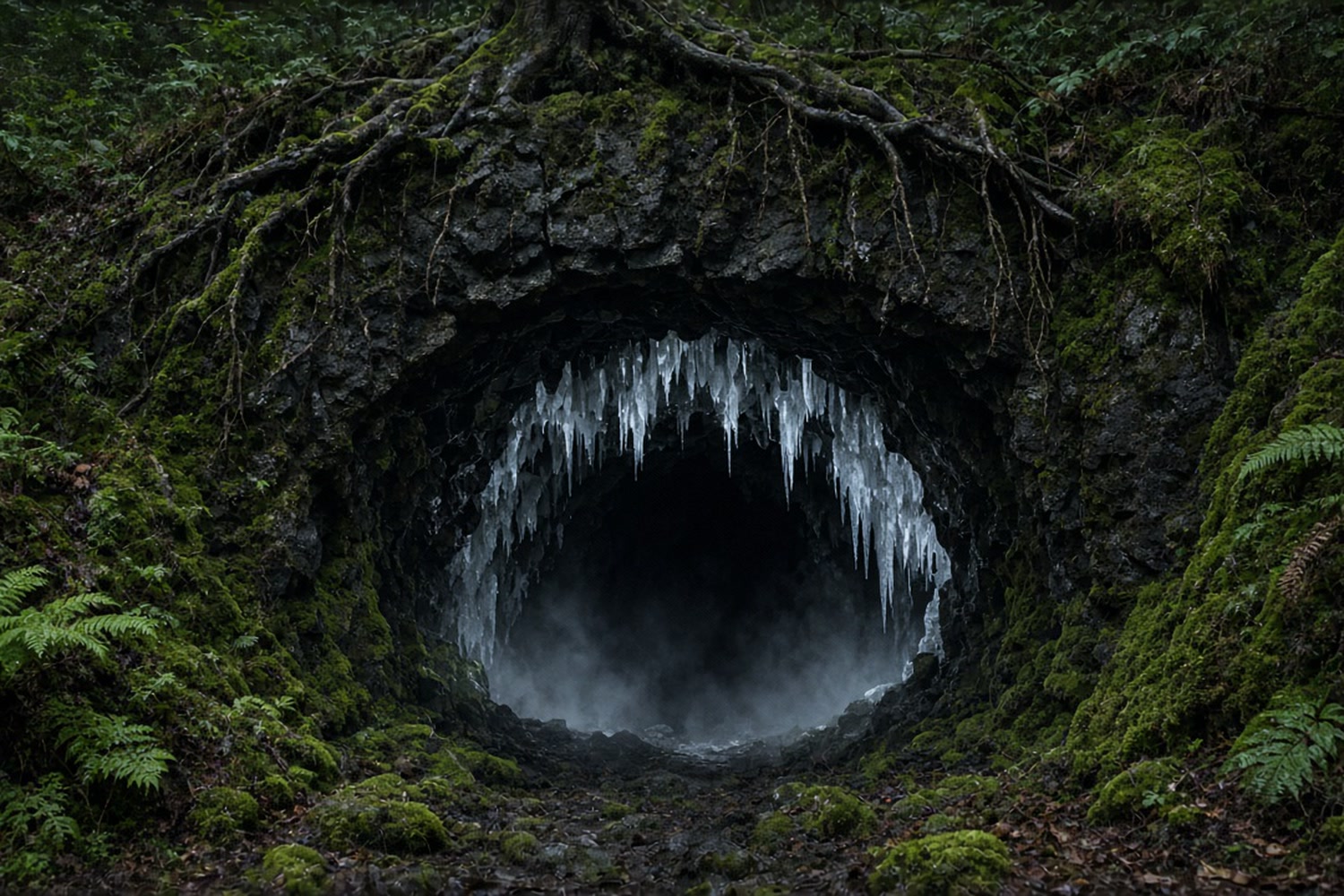
The caves. Two lava caves are developed and public, Narusawa Ice Cave and Fugaku Wind Cave, both holding ice year-round and both historically used to store silkworm eggs. Dozens more are unmapped. Reports from the undeveloped tubes are the sparsest and the most consistently frightening, which is what you would expect from confined dark spaces with no reference points and near-total silence. Do not enter one without caving training and a surface contact.
The media era. The forest entered the Japanese popular imagination through a 1960 Japanese crime novel that placed a death there and was adapted repeatedly. Everything since has been amplification: paranormal television, a 2016 American horror film, and in 2018 an online video by a foreign content creator that filmed a body and produced international condemnation. That last incident is the reason many Japanese guides now refuse foreign paranormal crews outright.
If You Are Going
Yamanashi Prefecture stopped publishing figures for this location in the early 2010s, deliberately, to reduce its notoriety. Researchers cite Aokigahara as a textbook case of a place becoming known for something largely because it was reported as being known for it. Whatever you publish about it becomes part of that loop. Write accordingly.
Practical protocol:
- Stay on marked trails. The Ice Cave to Wind Cave route is well travelled and covers real forest.
- Two navigation systems minimum, neither of them your phone alone.
- Hard turnaround time, agreed before entry, honoured regardless of what you think you are recording.
- Surface contact who knows your route and your out-time.
- Log ambient temperature and sound levels on arrival. The baseline here is nothing like your usual sites and your data is meaningless without it.
- If you find something human, you stop. You mark the position, you leave, and you contact the police. You do not photograph it. This is not squeamishness, it is the line between investigation and the thing that got that video’s creator condemned worldwide.
What It Actually Is
In 2013 Aokigahara was included in the Mount Fuji World Heritage listing, as part of the mountain’s sacred landscape. That is the other half of the truth about this place, and the half the horror content leaves out. It is a thousand-year-old lava field growing a forest on bare stone, ringed by lakes a volcano carved out of one larger lake in a single night, threaded with ice caves that kept silkworm eggs cold for Edo-period farmers.
It is also a place where a great many people died alone and where families still come to grieve. The yūrei may or may not be there. The sorrow definitely is, and it is the one thing at Aokigahara that no investigator has ever had trouble detecting.
Leave a Reply