
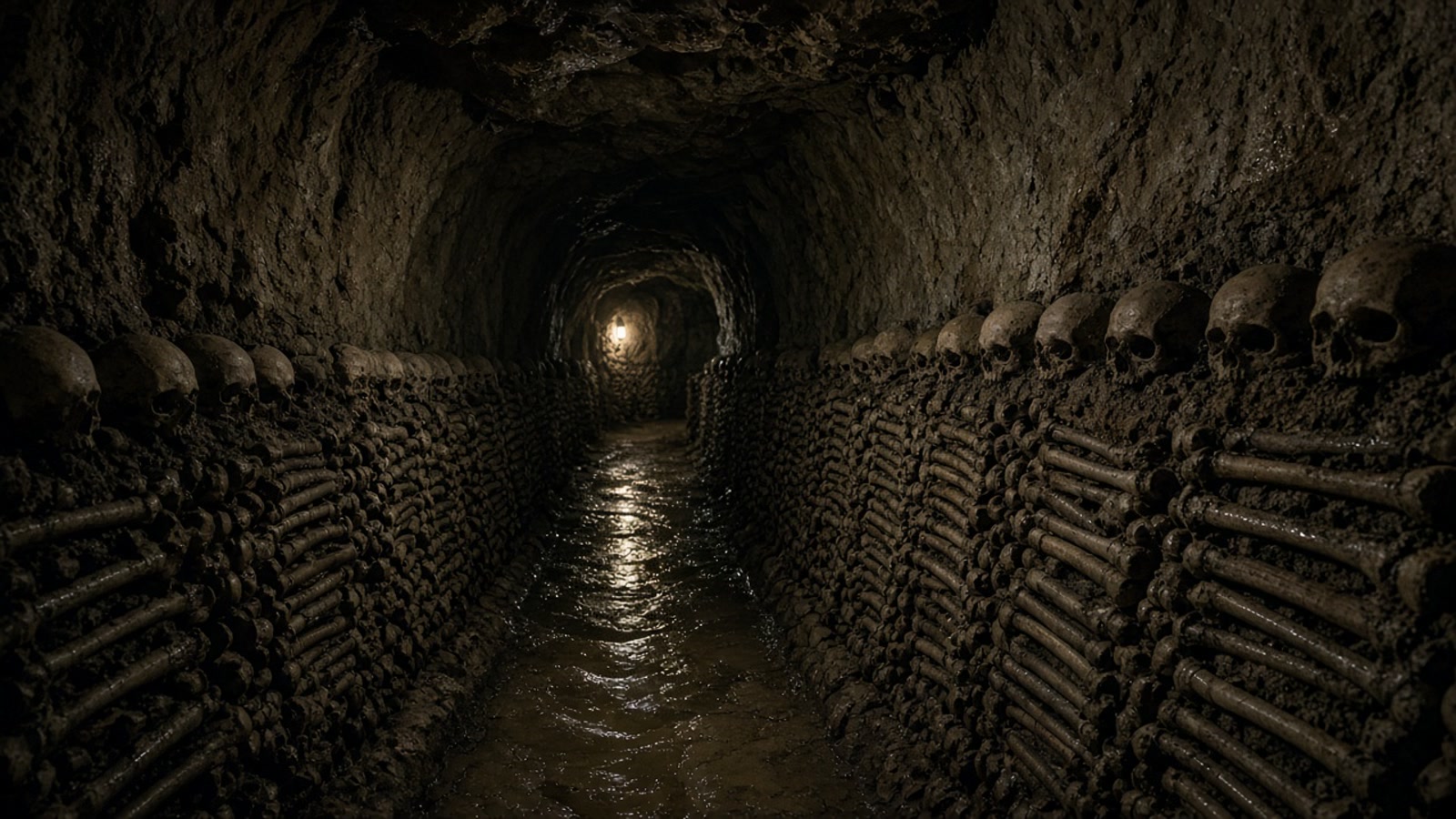
A field report on the ossuary under Denfert-Rochereau, the quarry network the public never enters, and what down there is still unaccounted for.
You leave a Paris pavement through a former toll-house, and the day stops at the top of the stairs. A hundred and thirty-one steps drop you about twenty metres into limestone that was a seabed long before there was a city. The air is cool and still. Water ticks somewhere you cannot see. Then the passage turns, and the walls are no longer stone.
The Stone Under the Streets
The bank you are walking in is Lutetian limestone, between about forty and forty-eight million years old, laid down when a warm sea covered the Paris basin. The Romans, who called the place Lutetia, cut this “Paris stone” from open pits along the Bièvre valley. When the easy outcrops were gone, the workings went underground. By the late Middle Ages the quarrymen were taking the whole bank and holding the ceiling with dry-stone pillars, the piliers à bras, and with walls called hagues that kept the rubble back and the path clear. A well system was raising stone by the fifteenth century.
At Tombe-Issoire, under the old plain of Montrouge, the galleries were abandoned long before the city needed them. The museum calls them one small part of a labyrinth of about eight hundred hectares. In 1774 the street gave way. A collapse swallowed roughly three hundred metres of the route d’Orléans, now avenue Denfert-Rochereau. The quarry service’s own teaching dossier puts the drop at twenty-five metres. On 15 September 1776 a royal decree stopped extraction under the public roads. On 4 April 1777 Louis XVI created the Inspection Générale des Carrières to find the voids, draw them and hold the city up. Charles Axel Guillaumot, its first head, would be the man charged with turning one abandoned working into a place for the dead.
Shells of that sea are still in the walls, and a well on the public circuit, the Quarriers’ Footbath, drops into a lower bed of the same stone. This was a mine before it was a cemetery. The city filled it afterwards.
Why the Dead Were Brought Down
The cemeteries failed in the same years. The largest, the Saints-Innocents, had taken the dead for nearly ten centuries, in the earth and in charnel houses above it. In 1780 the common grave slumped. The city records that hundreds of bodies poured into the cellar of a building on the rue de la Lingerie. The cemetery was closed. From 1785 to 1787 the tombs, the pits and the charnel were emptied. The bones moved at night, so Parisians and the Church would not meet the carts, and were tipped down two quarry wells. Quarrymen piled them in the dark. On 7 April 1786 the Tombe-Issoire workings were blessed and consecrated as the Paris Municipal Ossuary. From that day they were called the Catacombs, after the Roman ones.
Transfers continued through the Revolution and on to 1814, from cemeteries such as Saint-Eustache, Saint-Nicolas-des-Champs and the Bernardins, then again in 1840 and, under Haussmann, from 1859 to 1860. The museum dates the last deposits to 1860.
The official leaflet speaks of several million Parisians. A figure of about six million is often repeated; nobody counted the wells skull by skull, so it remains an estimate, not an inventory. Nobles, clergy and the unnamed poor went down the same shafts. Other cities have moved a mass of dead out of sight and then found the place would not stay merely administrative. Poveglia, the quarantine island in the Venetian lagoon, is one. Paris put its dead under the street, and built a door.
The Circuit You Can Walk
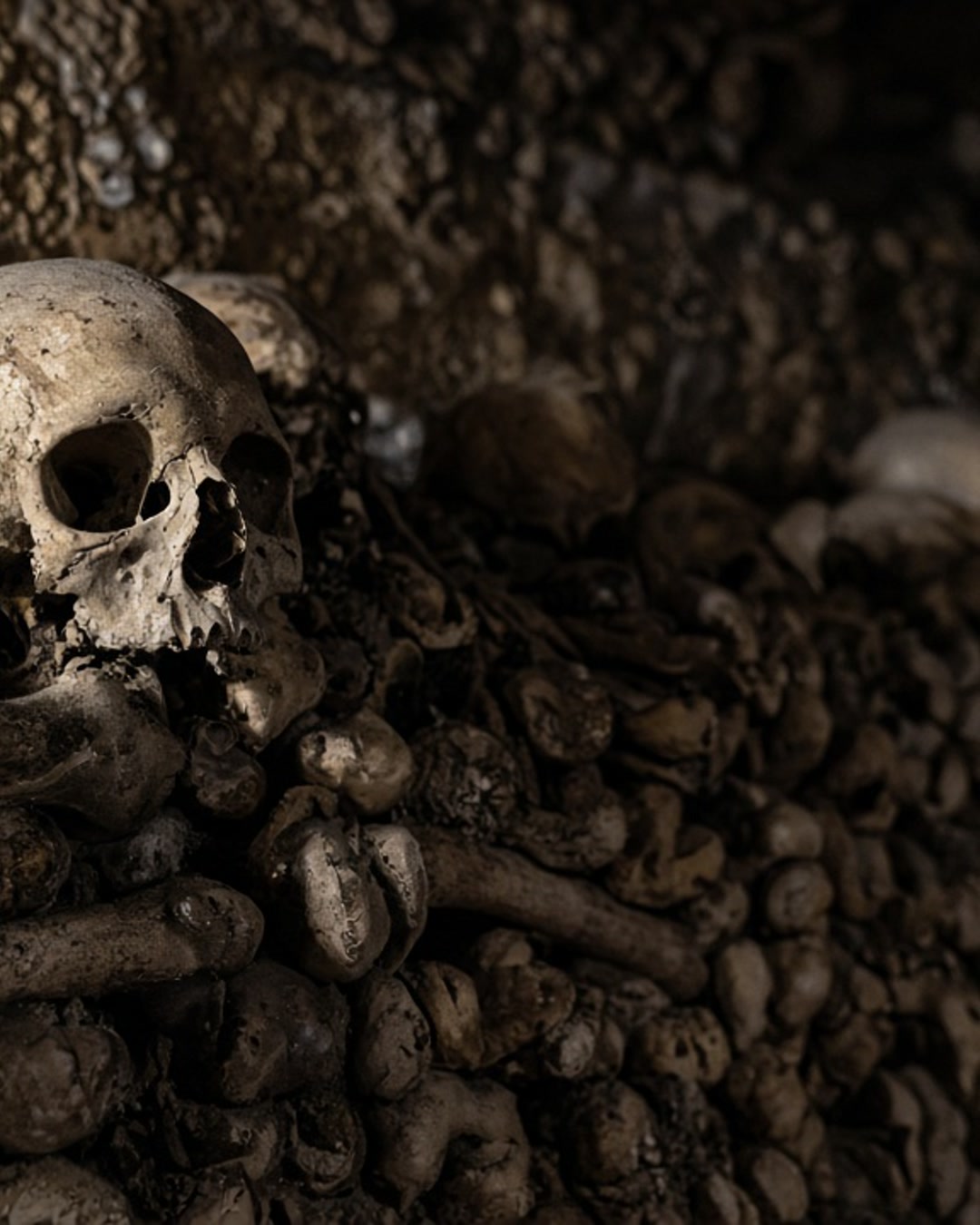
Before the public was admitted, the inspector Héricart de Thury rebuilt the loose piles, a work the museum dates to about 1810–1814. Femurs and tibiae were stacked with lines of skulls, like a quarry wall. The remaining bones, often broken by the fall down the wells, were heaped behind that façade. He named stations on the route — the Lacrymatory Sarcophagus, the Samaritan Fountain, the Sepulchral Lamp — and set plaques that ask the walker to think about dying. At the threshold the stone still says, in the museum’s own English, “Stop, this is death’s empire!”
Opened by appointment in 1809, the circuit filled a visitors’ register at once. The future Charles X came in 1787, Francis I of Austria in 1814, Napoleon III and his son in 1860. The doors are now open without a special permit. The city, writing in 2026, put the yearly crowd at about 600,000, and that April the ossuary reopened on a renewed circuit after months of work. The entrance is the restored Ledoux pavilion at 1 avenue du Colonel Rol-Tanguy, Place Denfert-Rochereau.
The visit is about 1.5 kilometres and an hour, across some 11,000 square metres, with 112 steps back to the street. The same square hides a separate wartime shelter, used as a command post in August 1944. It is not the bone galleries. More than one history has borrowed this dark.
What the Closed Galleries Keep
“Catacombs”, the museum insists, means the ossuary. Using the word for every quarry under Paris is a mistake. The Inspection Générale des Carrières still inspects several hundred kilometres of gallery accessible under public ground, in Paris and the three inner suburbs. Limestone workings alone undermine some 770 hectares inside the city, under the 5th, 6th, 12th, 13th, 14th, 15th and 16th arrondissements. Most of that is shut: shafts filled, mouths walled, iron doors set where a person might still pass.
The reports that cling to these passages are small, and they repeat, from visitors and from people who have worked the underground after the doors close. A footstep that matches yours, then one more after you stop. A voice in a turning that is empty when you reach it. A figure far down a line of skulls, never close enough for a face, gone when the light arrives. Other visitors on a one-way loop, and water in the stone, can counterfeit some of that. They do not cover an empty gallery, and they do not touch the closed network, where there is no next group.
Since 1955 it has been an offence to enter the rest or to move about in it. The ban took those passages off the register. It did not empty them.
A Fortress Cut into a Gallery
One gallery has a story that is also a death.
Décure, a quarryman on the late-eighteenth-century consolidations, had known the fortresses of Port Mahon, on Menorca, as a soldier in the Seven Years’ War. In his own hours he cut those forts into the limestone from memory, with a floor of black flint. In 1782, opening a way to a higher level, he brought a collapse down on himself. The museum’s dossier tells it without romance.
The carvings outlived him. A medieval quarry of the same name, beside the ossuary, was bought by the city in 2021. It is a protected monument, and it is not a public route except on the rare day the doors are opened on purpose. Décure is the story tied to a specific gallery: he cut a memory into the rock, and the passage he opened is the one that killed him.
The Man Who Was Missing for Eleven Years
The clearest case of someone who went down and was not accounted for is Philibert Aspairt, also written Asper.
In November 1793 he went down and did not come up. A stone in the closed network, under the rue Henri-Barbusse — the old rue d’Enfer — says he was lost on 3 November 1793, found eleven years later, and buried there on 30 April 1804. The civil record calls him a quarryman of sixty-two, born at Salmeranges, living on the rue Saint-Jacques, missing from home for ten or twelve years, found dead under the rue d’Enfer. He is also remembered as doorkeeper of the Val-de-Grâce. Later tellings add a search for wine in the Chartreux cellars. The 1804 paperwork gives no motive and no cause of death, and spelling, trade and the exact day do not match from stone to register.
The mismatch is not a verdict. A body was found, and a monument still stands where it lay, in a gallery you cannot book.
The closed galleries have lost the living for days at a time since. In June 2017 two boys, sixteen and seventeen, spent three days in the passages off the tour. Firefighters and dogs found them. They were treated for hypothermia, and otherwise unharmed. For three nights nobody above ground could say where they were. We know their story because they were found. The shut network does not publish everyone who has been into it.
Rooms the Map Did Not Show
The closed ground has also produced rooms no plan had listed.
In the late summer of 2004, police on a training exercise under the Palais de Chaillot, in the 16th arrondissement, entered a cavern of about four hundred square metres, some eighteen metres down. Seats were cut in the rock. There was a screen, a bar, tables, wired electricity, telephone lines. A spokesman said they had no idea who had built it. Three days later the lines were cut, the furnishings were gone, and a note told them not to try to find the people who had been there. Someone later claimed the work. The first official word is the one that lingers: the city had not known the room was there.
Inside the ossuary the oddities were written down. In 1813 four goldfish were put in the Samaritan Fountain: they lived, did not breed, and went blind. In 1861 Nadar spent three months below with magnesium light, exposures of many minutes, dummies standing in for workers who could not hold still, and about a hundred plates. On the night of 2–3 April 1897 about a hundred people heard forty-five musicians, illegally, in the rotunda of the tibias. Guards had been paid to look aside. The city still calls it a scandal. None of this is, by itself, a haunting. It is evidence that the dark has always held more than the surface was told.
If You Are Going
- Use the public door at 1 avenue du Colonel Rol-Tanguy. The circuit is one way, about an hour, 131 steps down and 112 up. It is a cemetery. Do not touch the bones, and do not take anything.
- Do not enter the closed network. It has been illegal for decades, and it is where people are lost. Trespass is not a method.
- If you are listening, note where you are on the loop, whether a group is ahead, and the moment your own steps stop. A gallery can return a footfall a beat late. Write down what does not match.
- The route reopened in April 2026 after works. Confirm the day before you go.
Still Unaccounted For
The public kilometre and a half is not the Catacombs of Paris. Behind the façade of femurs, the rest of the dead are piled out of the light. Port-Mahon keeps a medieval dark behind its grille. Aspairt’s stone is in a gallery with no ticket. Under Chaillot a furnished room was there, and then it was not.
Most of the remaining passages are shut, and some are still walked by people who never sign a book on the way out. A step that will not stop, a voice in an empty turning, a figure that will not come into focus: none of that was entered beside the dates of the bone transfers. Those dates are history. The rest of the file is open, because the tunnels are. The empire of the dead is not finished with the living.
Leave a Reply