
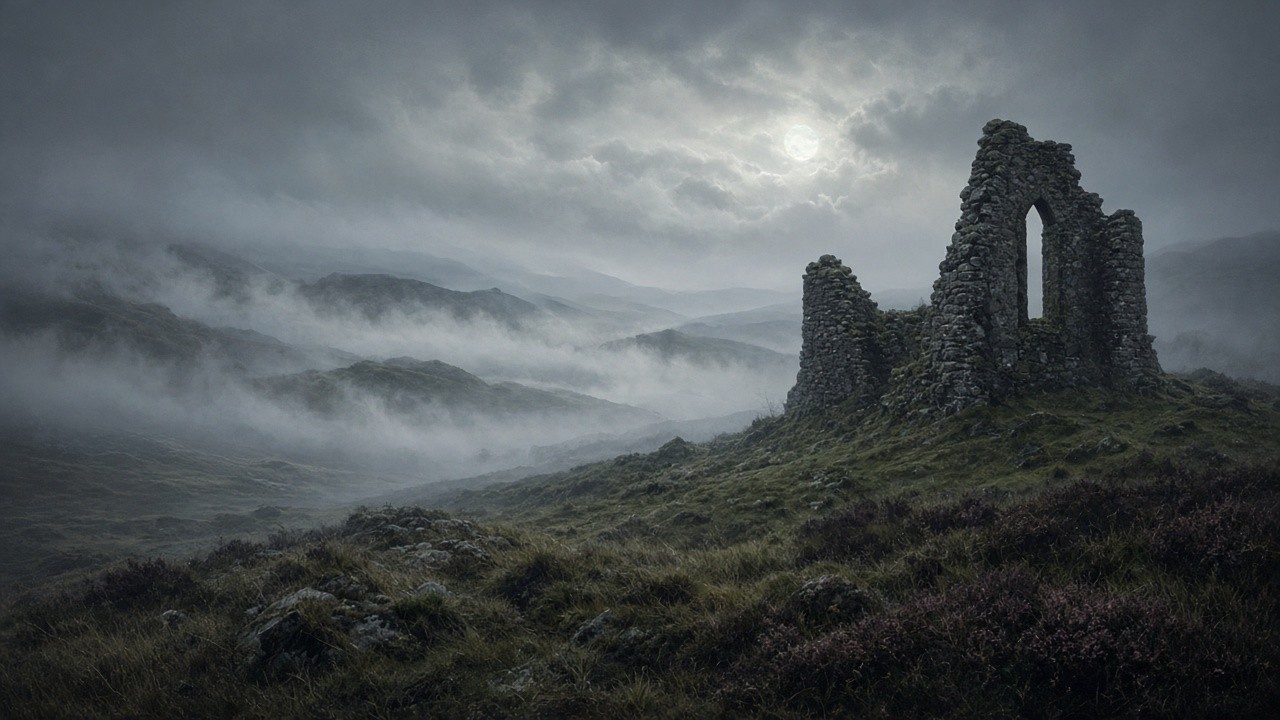
A field report on the bean sídhe: the cry outside the house at night, the families she follows, and the encounters that still arrive before bad news.
This article contains affiliate links; Italian Ghost Hunters may earn a commission if you buy through them.
Some spirits cling to a building. The banshee clings to a bloodline. Across Ireland, and in Highland Scotland under a related name, witnesses describe the same opening: a woman’s lament rising in the dark, thin at first, then suddenly close to the eaves or the lane, and by morning word of a death. She does not haunt a corridor. She announces. For investigators who take Celtic testimony seriously, that distinction matters. The banshee is not a house ghost looking for company. She is a messenger from the Otherworld, and the message is always the same.
The Legend as It Is Told
In Irish, bean sí — older spelling bean sídhe — means a woman of the síd, the fairy mound: the ancient earthen hills that still stand in fields from Clare to Donegal. English speakers say banshee. The core belief, recorded for centuries in rural memory, is lean and unsentimental. When a member of certain families is about to die, a solitary female spirit cries outside the home. She does not cause the death. She foretells it. The dying person usually does not hear her. Relations and neighbours do.
Her cry is keening — the same raw, rising lament that living women once performed at Irish wakes. Human keeners sang after a death. The banshee sings before it. That timing is the whole of her work. Accounts say the interval between the cry and the death may be minutes, or a day or two. Sometimes the person has already died far away, and her wail is the first news the household receives, days before any letter or messenger can arrive.
When she is seen as well as heard, the descriptions diverge, and that divergence is itself part of the tradition. Sometimes she is young and beautiful in a white or grey cloak. Sometimes she is small and old, hair white or red and hanging loose, eyes red from weeping. Many tellers place a comb in her hand. She sits or stands in a high place — a hill, a wall, a tree line overlooking the house — and the sound moves. That is the legend as told. What makes it powerful for field work is not that every county agrees on her height. It is that the cry keeps returning to the same kind of night, the same kind of family waiting room, and the same sense that something outside already knows.
Regional Variants
Ireland holds the best-known form, but the death-messenger is not a single map pin. In the south-east — Wexford, Carlow, Kilkenny, Tipperary — she has long been called the Bow or the Badhbh, a name that reaches back toward early Irish battle goddesses who foretold slaughter. In Waterford she is the Bibe. Elsewhere she is simply the bean chaointe, the keening woman. The cry may be mournful and human in one district and strangely animal in another. Folklore collectors who mapped these differences found continuity beneath the names: a solitary Otherworld woman, attached to families, heard before a death.
Scotland keeps a close relative: the bean nighe, the washerwoman at the ford. Highland and Hebridean tradition places her beside lonely streams, washing the bloodstained clothes or grave-linen of those about to die. She is widely regarded as a type of ban-sìth — the Scottish kin of the Irish banshee — but her sign is visual and wet rather than a wail at the eaves. Some lore holds that women who died in childbirth are bound to that washing until the natural span of their lives would have ended. The washing image also survives in older Irish literature, where a woman at a lake or river washes limbs before a battle and names the doomed. Over centuries the Irish figure softened into the family mourner of later folklore, while Scotland kept the washer at the water.
Historical and Cultural Roots
The banshee did not arrive with Victorian ghost books. A fourteenth-century history of the O’Brien wars in County Clare already records Otherworld women appearing before slaughter — washers at fords and lakes who announce who will fall. That layer is older, fiercer, and closer to battle prophecy than the later household keen. Scholars still debate exactly how the grim washer became the family mourner, but the thread is continuous: a female spirit tied to the síd, speaking death aloud before the body cools.
Traditional Irish mourning supplies the second root. For generations, wakes included the caoineadh, a sung lament performed by women of the family or by professionals hired for their skill. The custom faded through the nineteenth and early twentieth centuries as funerals grew quieter and more private. The banshee’s cry is described in the same vocabulary those keeners used. Major folklore study of the belief has treated her as a supernatural counterpart to that living craft — grief given a throat that does not belong to anyone still breathing.
Family attachment is the third root, and it carries social weight. Tradition holds that she follows old Gaelic lines, especially names beginning with Ó or Mac — O’Briens, O’Neills, O’Gradys, Kavanaghs and others named again and again in local memory. The rule was never airtight. Some Anglo-Norman houses that had lived long enough in Ireland to be counted as Irish were also said to have her, and later tellers recorded her attending households outside the strict Gaelic list. To have a banshee was, in rural status terms, a mark of antiquity. Your deaths mattered enough to be mourned from the Otherworld.
How Belief Shaped Behaviour and Places
Belief in the banshee has never been only a fireside story. It has shaped how people behave around death, night roads, and small objects left on the ground.
The comb is the clearest example. In many districts, if you found a comb lying by a lane or ditch, you left it alone. It might belong to her, and she would come back for it. Interference legends warn that people who picked one up were visited until they returned it — sometimes through a window, sometimes with marks left on the hand that had touched it. Other taboos discourage calling out to her, mocking her, or trying to seize her. Communities that still speak of her treat contact as something you do not reach for.
Geography matters too. Fairy mounds and lonely fords already carried Otherworld associations; the banshee simply gave those places a specific sound. A cry heard from a high field above a farmhouse, or from the direction of a mound no one ploughs, arrives already named. Belief also shaped mourning itself. When death still happened at home, neighbours listened for her. When death moved into hospitals and silence, the living space where her cry made sense began to shrink. Privatised death removes the communal night in which a keening messenger once had an audience.
For investigators, that history is field condition. You are not only chasing a sound. You are working inside a culture that already decided what certain night sounds mean, and where it is unwise to answer them.
Modern Sightings as Real Encounters
The accounts that matter most are the ones told as personal encounter: a cry outside a particular house on a particular night, followed by news that a relative had died — sometimes abroad, sometimes in the next room.
The pattern reported across Irish counties for generations is stubbornly consistent. The sound comes first. It rises and falls like a woman weeping, yet no woman stands on the road. It seems to move — closer to the gable, then away toward a hill or hedge. People who go out with a lantern find nothing. In the morning, or within a day or two, the death is confirmed. Visual reports speak of a cloaked woman at a window or under trees, long hair loose, sometimes combing, who vanishes like mist when approached. A seventeenth-century English visitor staying with an O’Brien household in Clare left one of the earliest written eyewitness notes of this kind: a pale woman in white at the window in the night, a cry, and news by morning that a family member had died under that roof.
Folklore collectors working deep into the twentieth century, and ethnographers in rural districts more recently, have still found people willing to say they heard her — or that a parent or neighbour did, just before word of the death arrived. Belief in fairies generally may have thinned. Belief that the banshee is a stand-apart death messenger has proven harder to erase. That is not laboratory proof. It is continuous testimony from people who had little to gain by inventing a wail outside their own door. Folklore is how communities store encounters that would otherwise be lost between one wake and the next. The question for the open file is why so many households, across so many decades, keep reporting the same cry in the same narrow window before grief arrives.
Why the Story Endures
The banshee endures because she fits the night she haunts. Grief already has a sound everyone recognises. Darkness erases distance. A cry that knows your family before you do needs no special effects to freeze a listener in bed.
She also endures because she is unfinished. In every telling she is still working. The next death has not yet been announced. The comb may still be lying in the grass. That open ending is what keeps her attached to names and lanes, and what keeps listeners leaning toward the window when something outside weeps without a living throat.
She is a reminder that the strongest Celtic legends are not only castle spectres and battlefield ghosts. Ireland and Scotland carry a messenger who belongs to kinship itself — tied to mounds, fords, wakes, and the thin edge between a warning and a presence. If you work rural ground where her name is still spoken, log ambient sound on arrival, note wind in the hedges and dogs in the yard, and if you hear a woman keening where no wake has been called, do not answer until you are certain the voice has lungs that will take another breath.
The file on the banshee has never closed. On the right kind of Irish night, outside the right kind of house, it still sounds as if someone is writing the next page in a voice that was never born.
If the cry outside the house has you thinking about turning legends like this into your own ghost mystery novel, Ghost Mystery Writer is a downloadable library of 456 prompts for writing complete ghost mystery novels with a free AI chat assistant, built for people who self-publish on Amazon.
Leave a Reply