
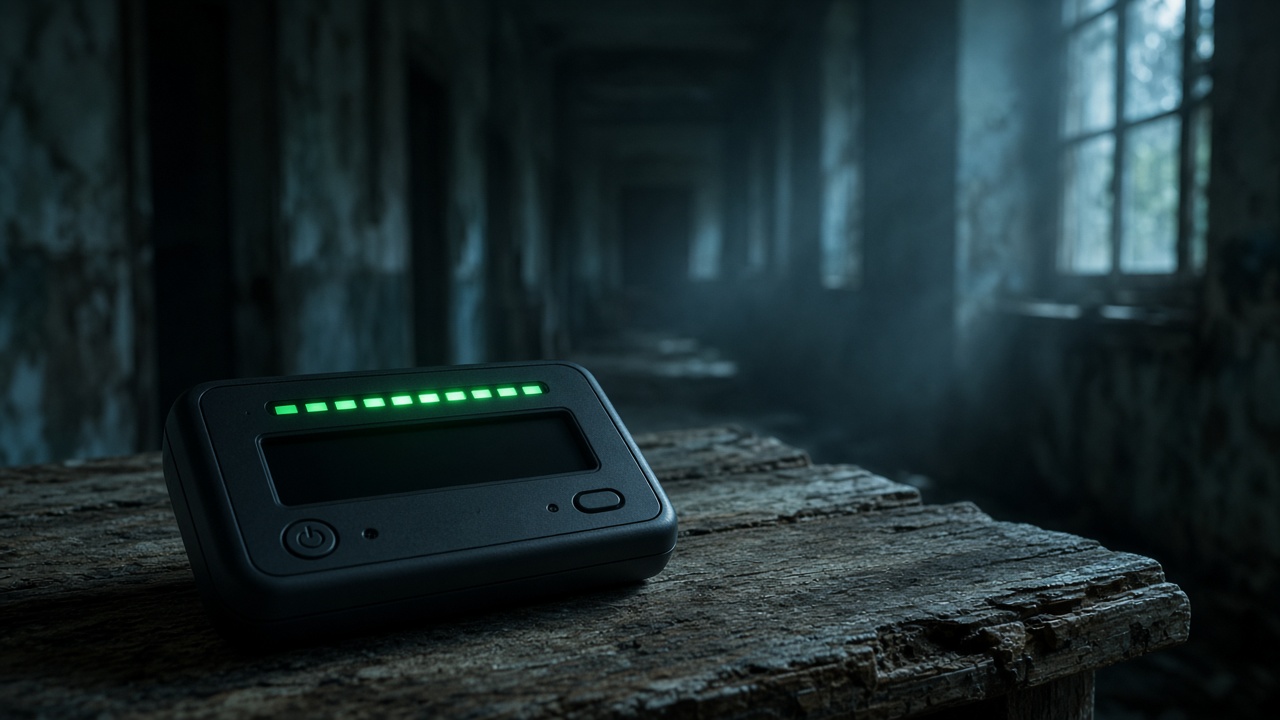
What an EMF meter actually measures, which models investigators reach for first, and how to use one so the reading you capture is worth keeping.
As an Amazon Associate, Italian Ghost Hunters earns from qualifying purchases.
An EMF meter does not prove a ghost. It never has. What it does is give you a number — or a row of lights — for something you cannot see with your eyes: the electromagnetic field in the room you are standing in. Investigators have carried these instruments into cold cellars, empty corridors and locked upper floors for decades, because so many reported encounters arrive with the same accompanying detail: the lights on the meter climb when nothing ordinary seems to be switching on.
This guide is for someone building a first kit. It covers what the instrument measures, three well-known meters sold on Amazon.com with published specifications you can verify yourself, and a field protocol that treats spikes as candidates for evidence rather than as automatic proof. Check the current price on each product page before you buy; listings move.
What an EMF Meter Is Actually Reading
Electromagnetic fields are produced by anything that carries current: wall wiring, a phone charger, a fridge compressor, a router, a torch left on in a bag. Household metres usually report magnetic field strength in milligauss (mG) or microtesla, and some also read electric fields or radio-frequency energy. Ghost-hunting teams watch for sudden, unexplained rises against a room they have already baseline-mapped.
The working idea in the field is simple. Map what the building does when everything ordinary is accounted for. Then watch for readings that refuse to match that map. A meter that climbs in a dead corner, away from sockets and appliances, while temperature, sound and motion stay quiet, is the kind of event teams log and return to. Ordinary interference is not the enemy of that process. Mapping interference is how you keep the unexplained reading clean.
Three Meters Worth Knowing
The models below are real Amazon.com listings with published manufacturer details. Specs here come from those pages and from the makers' own documentation. We have not hands-tested these units for this article. Confirm stock, seller and current price on Amazon before you order.
K-II EMF Meter — the classic LED ladder
The K-II EMF Meter is the handheld many people picture when they hear "ghost meter": a compact grey unit with a multi-segment LED display that climbs as field strength rises. According to the listing, it offers instantaneous response to EMF fluctuations and spikes, push-on/push-off operation, claimed accuracy of 5% at 50–60 Hz, and detection across an ELF range (50 to 1,000 Hz) and a VLF range (1,000 to 20,000 Hz). It runs on a single 9V battery. The manufacturer notes it is intended to measure electric fields and does not detect nuclear radiation. The model name on the listing is K-II-DELUX.
Why investigators like it: the lights are readable in near-dark without staring at a numeric screen. You can watch a teammate's face and the meter at the same time. Why you still need discipline: a phone in a pocket, a walkie-talkie, or a live socket can light the same ladder. The K-II is a fast visual cue, not a full environmental log. Check the current price on Amazon; availability of authentic units has varied over time, so read the seller notes carefully.
TriField TF2 — magnetic, electric and RF in one body
The TriField EMF Meter Model TF2 is built by AlphaLab, Inc. and sold as a three-mode instrument: AC magnetic, AC electric, and radio/microwave (RF). The Amazon listing and the maker's documentation describe a 3-axis magnetic sensor, single-axis electric and RF modes, an LCD with peak hold, audio assist for pinpointing sources, and operation on a 9V battery (more than twenty hours with backlight off, according to the manufacturer). Magnetic and electric coverage is listed around 40 Hz–100 kHz; RF coverage is listed around 20 MHz–6 GHz. The package typically includes the meter, battery, quick-start card, manual and a soft carry case. It does not detect radioactivity.
For ghost hunting, the TF2 earns its place as a baseline tool. Before you chase spikes in the dark, you can walk a site in magnetic mode, then electric, then RF, and write down what the building already produces: a buzzing breaker panel, a Wi-Fi router pulsing on a shelf, a smart meter on an outside wall. When a later session shows a rise that does not match that map, you have something worth replaying on audio and video. Check the current price on Amazon.
Mel Meter 8704R — EMF plus ambient temperature
The Mel Meter 8704R is sold specifically into paranormal research kits. Listing features include digital EMF and ambient temperature readouts on a red backlit display (night-vision friendly, can be turned off), high/low memory so you can leave the unit and return to see extremes, an EMF "burst" mode (about 100 ms sampling) for faster fluctuation response, a built-in IR-safe flashlight, and power from a 9V alkaline battery (often not included). The model number on the page is 8704R.
What makes it useful on a quiet floor is correlation. Investigators often report cold spots alongside meter activity. A single instrument that logs both field and temperature lets you timestamp whether a chill arrived with a spike or wandered in alone. Burst mode is there when you want the meter to prioritise rapid EMF sampling over temperature. Check the current price and what the seller includes (case, battery) before you buy.
How to Use an EMF Meter So the Evidence Holds
Treat the first twenty minutes on site as mapping, not hunting. Power the meter, note the battery state, and walk every room you plan to work with lights on and ordinary equipment in its usual places. Write down steady readings near fuse boards, routers, refrigerators, chargers and any room that already feels "active" to the people who live there. That notebook page is your baseline. Without it, a spike later is just a light show.
Then strip the ordinary sources you can control. Phones on airplane mode or left outside the room. Radios and spare torches off unless assigned. One person moving at a time when you are watching a hotspot. If a reading climbs, do not celebrate — investigate. Step back. Rotate the meter if it is single-axis. Ask whether a teammate just walked past with a camera light. Ask whether a boiler or pump kicked in. Only when the rise survives those checks do you mark time, place, temperature, who was present, and what else was recording.
Ask questions if your team uses call-and-response with meters. Keep them short. Leave silence after each one. A ladder of lights that answers on cue once is interesting; a ladder that answers while a phone is buzzing in a coat is not. Film the meter face when you can. Memory invents drama. A timestamped clip does not.
Interference You Should Map, Not Fear
Wiring in old walls can create pockets of elevated field that feel like rooms with a personality. Dimmer switches, transformers and charging bricks are frequent culprits. Lift shafts and plant rooms hum. Smart devices wake on schedules you have not met yet. None of that means spirits are absent from a location. It means your job is to know the building's electrical voice so a new voice stands out.
A practical habit: when you find a hot corner during baseline, stick a label in your notes — distance from the nearest socket, whether the reading falls when you unplug a lamp, whether RF mode on a TriField-class meter lights up when a phone unlocks. You are not debunking the night. You are clearing the channel so that if something answers later, you can trust the file.
Building a Small Kit Around the Meter
An EMF meter works best beside other quiet instruments. A digital audio recorder for EVP, a second thermometer or the Mel's own temperature channel, a notebook that does not rely on a phone screen, spare 9V batteries sealed in a pouch. If budget allows, pairing a simple LED meter such as the K-II for live sessions with a numeric multi-mode meter such as the TF2 for site surveys gives you both theatre and paperwork — the flash of a response, and the numbers you can publish in a report.
Start with one meter you will actually carry. The best instrument in a drawer has never caught anything. Learn its idle behaviour in your own hallway before you take it into a reputedly active cellar. When you know how it reacts to your router and your kettle, you will recognise when a strange house is doing something else.
What Remains Open
Meters measure fields. They do not name the source. Across years of investigation reports, the same pattern repeats: a baseline room, a quiet interval, a rise that does not match the map, sometimes a cold shift, sometimes a voice on the recorder a moment later, sometimes nothing but the lights and a feeling that the room noticed you. Sceptical explanations exist for many individual spikes. They do not close every file.
If you are buying your first meter, begin with clarity about what you want. Fast visual feedback for walkthroughs points toward a K-II-style LED unit. Documentation and RF awareness point toward a TriField TF2. EMF-plus-temperature logging points toward a Mel 8704R. Check the current price on Amazon for each, buy from a seller you trust, and spend your first night teaching the instrument the difference between a living house and a mystery.
The mystery is still out there. Your job is to arrive with a meter that can tell the difference between the wiring and whatever else is in the dark.
Leave a Reply