
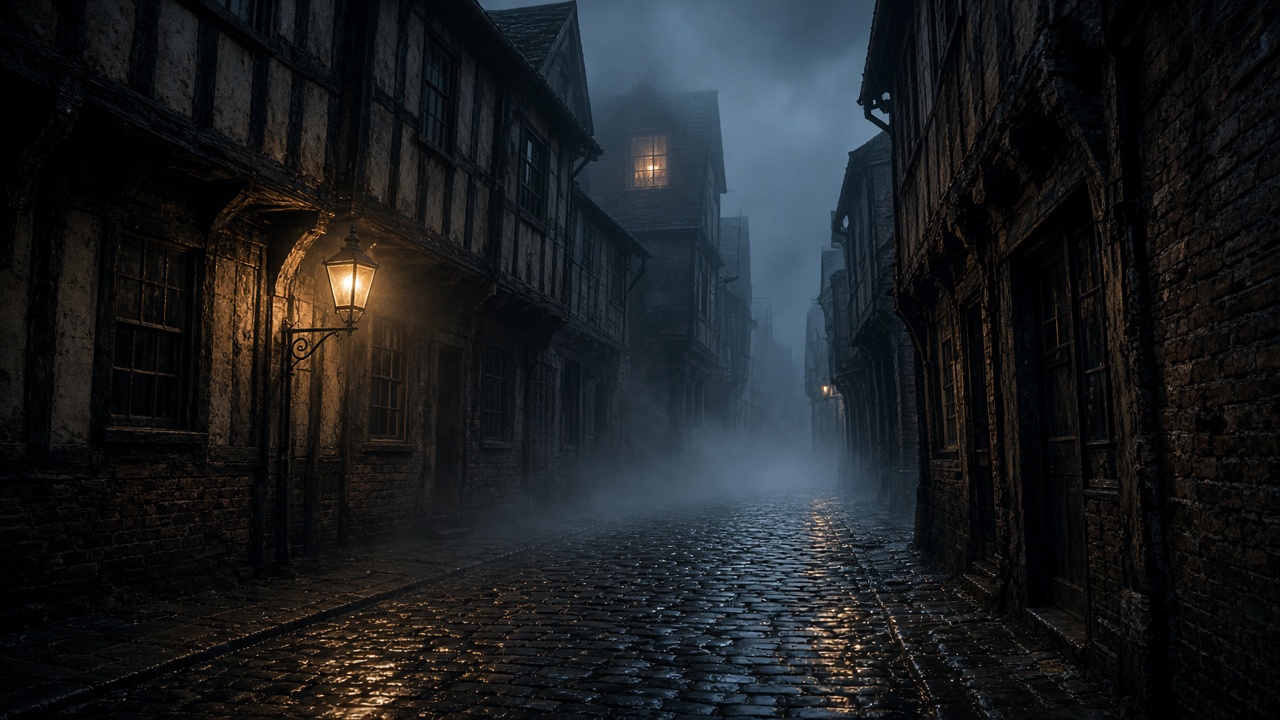
A field report from the 1762 record: knockings in a Smithfield lodging, a murder accusation from beyond the grave, and a city that turned out to watch.
This article contains affiliate links; Italian Ghost Hunters may earn a commission if you buy through them.
In the first weeks of 1762, a narrow lane beside London’s Smithfield market became impassable. Crowds pressed against a three-storey lodging house a short walk from St Paul’s, waiting for knocks and scratches from a room upstairs. London papers carried the story day after day. Clergymen argued over what the noises meant. Aristocrats arrived by coach. A young girl lay in bed while grown men asked a spirit, by code, whether a man had poisoned the woman he loved. The Cock Lane ghost was not a legend whispered in the countryside. It was a newspaper event, a public investigation, and one of the best-documented hauntings of the eighteenth century — preserved in pamphlets, court papers, and the evening press of its own week.
The Period and the Setting
Cock Lane ran through a respectable but declining quarter north of the church of St Sepulchre-without-Newgate, near the markets and the hanging bell of Newgate Prison. The house at the centre of the affair was ordinary: one room to a floor, a winding stair, lodgings let by a parish clerk who drank more than he could afford and owed money he could not easily repay.
The background, as set down in contemporary pamphlets and later case histories drawn from them, begins a few years earlier. A Norfolk man who had worked as a usurer and postmaster lost his wife in childbed. He later lived as husband and wife with her sister — a union the church’s law forbade when a living child had been born of the first marriage. The couple took rooms with the parish clerk on Cock Lane. The clerk borrowed twelve guineas from his lodger. Scratching and rapping were already reported while the sister, several months pregnant, shared a bed with the clerk’s elder daughter — a girl of about eleven — during a period when the man of the house was away. A neighbouring publican later claimed to have seen a white figure on the stair. The couple moved on to Clerkenwell. In early February 1760 the sister died of what her doctor and apothecary certified as smallpox. She was buried in the vault under St John’s, Clerkenwell. The Norfolk man inherited under her will. Her family resented it. The clerk never finished paying the loan. By January 1762 the creditor had recovered the debt through solicitors — and the noises in Cock Lane had returned in force.

What the Record Says
The phenomena, as reported at the time, clustered around the clerk’s daughter. Knockings and sounds likened to a cat scratching a chair seemed to come from her bed. The clerk had a carpenter strip the wainscotting. Nothing ordinary was found. He and an assistant preacher from neighbouring churches concluded that the spirit was the dead sister from Clerkenwell, returned with a message. They devised a code: one knock for yes, two for no.
Through that code the ghost appeared to claim she had not died naturally. She had been poisoned with arsenic, administered by the man she had lived with, about two hours before her death. The accusation was sensational enough for a London commercial daily to begin printing detailed accounts. Rival evening papers soon followed. By mid-January the lane outside was blocked with onlookers. The clerk charged an entrance fee. Séances were held upstairs: the girl undressed and put to bed before an audience; a relative of the household called the spirit by the dead woman’s familiar name; questions ran through the alleged murder, the will, and whether the accused would hang. When the accused man attended and heard a single knock affirm that he should be hanged, he cried out that the spirit was lying — that the woman he loved would never have said such a thing.
The ghost, witnesses said, followed the girl when she was moved to other houses. Nobles visited. A committee was eventually assembled under a Clerkenwell rector, with men of rank and learning present, including a celebrated lexicographer and moralist of the day. On the night of 1 February 1762 they put the girl to bed under supervision. For more than an hour they heard nothing. Later, ladies near the bed reported knocks and scratches; the girl said she felt the spirit like a mouse on her back. Required to hold her hands out of the covers, she produced no further evidence. The spirit had earlier promised, by knock, to rap on its own coffin in the vault of St John’s. Near one in the morning the company went down into the church vault. Silence. The committee’s published opinion was that the child had some art of making or counterfeiting a particular noise, and that there was no agency of any higher cause.
Further tests followed. In mid-February, at a house in Covent Garden, maids reported seeing the girl conceal a small board of wood, roughly six by four inches. Scratches were heard; observers concluded she could produce them, and that pressure from her father lay behind the performance. A clergyman who had once trusted the ghost published a retraction. In July 1762, at the Guildhall, the clerk, his wife, the relative who had called the spirit, a tradesman linked to the press coverage, and the assistant preacher were tried for conspiracy to take away the accused man’s life by charging him with murder. The jury found them guilty. The clerk was sentenced to the pillory and two years in prison; others received imprisonment or paid damages. Crowds at the pillory, unusually, took pity and collected money for him.
The Context of the Time
To understand why Cock Lane seized London, you have to hear the century’s arguments about spirits. Belief that the dead might return to warn the living was still common. Methodism, still young, was regularly criticised for taking supernatural claims seriously; Anglican establishments often preferred to treat such episodes as leftovers from a more credulous past. The Cock Lane affair became a proxy war: some clergy inclined to trust the knocks; others led the tests that emptied them of proof. A city still remembering recent fraud scandals watched a new sensation unfold in real time, amplified by a press that had only lately learned how to feed a daily hunger for marvels.
The accused man’s situation also mattered. He and the dead woman had lived as married without the church’s blessing. Her family had contested money. The clerk owed him. Murder by poison was the darkest possible reading of a death already certified as smallpox. A ghost that spoke in knocks offered what looked like evidence no living witness could give — and the papers made sure every coffee-house heard it.
What Later Research Found
Later historians working from the 1762 pamphlets, the committee report reprinted in biographical literature, the trial coverage, and the magazines of that year have largely confirmed the outline above. The commercial daily that first pushed the murder charge; the evening papers that amplified or doubted it; the vault test of 1 February; the wooden board; the July convictions — these are not Victorian embellishments. They sit in the contemporary record.
What the archives cannot settle is every private motive. Was the girl coached from the start, or drawn into a story adults had already named? How much did debt, family resentment, and genuine fear of the dark braid together in that upstairs room? A pamphlet sympathetic to the accused man — long attributed to a well-known essayist of the day — told the background from his side. Satirists and printmakers mocked the credulity of the town once the conspiracy verdict was in. A later novelist would still be joking about Cock Lane a century on. The historical file is rich. It is also, like most haunting files, incomplete about what anyone felt in the room before the newspapers arrived.
What the Story Tells Us About Its Era — and About Ours
Cock Lane is a lesson in how a haunting becomes public. The phenomena began as household noises. They became a coded interrogation, then a press campaign, then a civic investigation, then a criminal trial. Each stage changed the evidence. Crowds create expectation. Entrance fees create performance. A promise to knock on a coffin in a vault creates a test that silence can fail. Investigators today still meet the same slope: private anomaly, local story, media attention, adversarial proof.
It is also a lesson in leaving the strange parts strange. The committee of 1 February did not catch the girl mid-trick that night; they recorded absence of proof under their conditions, and a reasoned opinion that she could counterfeit a noise. The board came later. Between the first scrapes reported while the pregnant sister still lived in the house, and the July verdict, lie weeks of testimony from people who believed they had heard something they could not explain — including a publican who spoke of a white figure on the stair, and visitors who paid to listen and went away convinced. Fraud in the end does not automatically erase every report at the beginning. It tells us that once a story has a name, a code, and a queue in the street, the living will supply what the dead cannot.
For the field worker, Cock Lane remains useful precisely because it is so well documented. Read the period press if you can find it. Note who benefited. Note who was afraid. Note the moment the investigation moved from the bedroom to the vault. And remember that London in 1762 did not treat ghosts as impossible. It treated this ghost as a claim that had to be tested in public — and then could not stop talking about it when the test went quiet.
The lane is still there, rebuilt and ordinary, a short walk from the old market ground. The vault under St John’s has been rearranged by later centuries. What survives intact is the paper trail: knocks reported, questions put, silence in the coffin chamber, wood hidden in a bed, a pillory at the end of the lane. The Cock Lane ghost entered the archive as a sensation. It remains there as an open question about how a city hears the dead — and how quickly the living learn to answer for them.
If old newspaper hauntings like this make you want to turn archival mysteries into your own ghost novel, Ghost Mystery Writer is a downloadable library of 456 prompts for writing complete ghost mystery novels with a free AI chat assistant. It is built for people who self-publish on Amazon.
Leave a Reply