
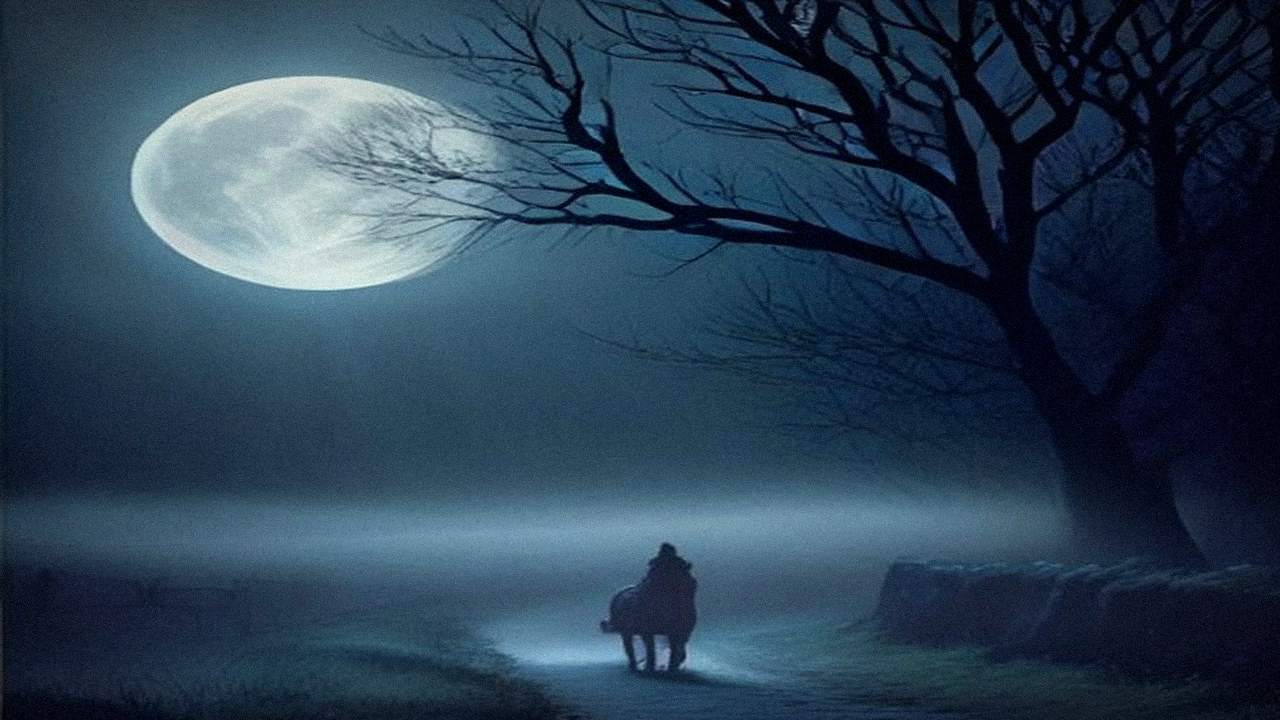
A field report on the headless horseman of Irish folklore: a rider who carries his own glowing head, a silent coach that comes for the dying, and the gold that might be the only thing that stops him.
This article contains affiliate links; Italian Ghost Hunters may earn a commission if you buy through them.
There is a particular kind of silence on an Irish back road after midnight. The hedges close in, the stone walls run grey in the moonlight, and the only sound is the wind combing through the hawthorn. Then, in the old stories, comes another sound: hoofbeats, fast and heavy, getting closer. A black horse breaks out of the dark with fire in its nostrils. The figure on its back sits tall and straight in the saddle, but there is nothing above its shoulders. Its head rides in the crook of its arm, and the head is looking at you.
This is the Dullahan, the Irish headless horseman of local folklore, and he does not ride for sport. Like the banshee, whose keening outside a house warns that someone inside will soon die, he is a messenger of death. The difference is that the banshee only warns. The Dullahan comes to collect. With Halloween a week away and the old season of Samhain closing in, there is no better time to open his file.
The Irish Headless Horseman Legend as It Is Told
The core of the story is told in much the same way from one county to the next. The Dullahan is a dark rider on a black horse who travels the lonely roads at night. He carries his own severed head, either tucked under one arm or held up high like a lantern to light the way ahead. The head is the most terrible part of him. In the traditional tellings its skin has the colour and texture of old, mouldering cheese, it glows with a faint, rotten light, its small eyes dart restlessly in every direction, and its mouth is stretched in a grin that runs from one ear to the other.
His whip is the other detail no one forgets. It is said to be made from a human spine, and he cracks it as he rides.
The Dullahan does not wander at random. He rides toward someone. When he reins in his horse, a person in that place is about to die. In many versions he calls out the name of the one he has come for, and at the sound of their own name spoken by that dead voice, the soul is drawn out of the body. There is no appeal and no bargaining. When he has spoken, it is done.
Nothing can bar his way. Locked gates are said to fly open as he approaches, and doors that were bolted for the night swing wide on their own. A fence, a wall or a river will not hold him back.
The Watchers at the Window
The old stories are very clear about one thing: the Dullahan does not like to be watched. Country people were warned never to look out at a rider passing in the night. Those who did were said to pay for it. In some tellings he throws a basin of blood into the face of anyone who peers at him from a window or a doorway, marking them as the next to go. In others he lashes out with his spine whip and takes an eye.
That is why, in the old rural districts, families drew the curtains and turned away from the glass when they heard hooves on the road after dark. Better not to know who he was riding for than to become the next name on his list.
The Coiste Bodhar: The Silent Death Coach
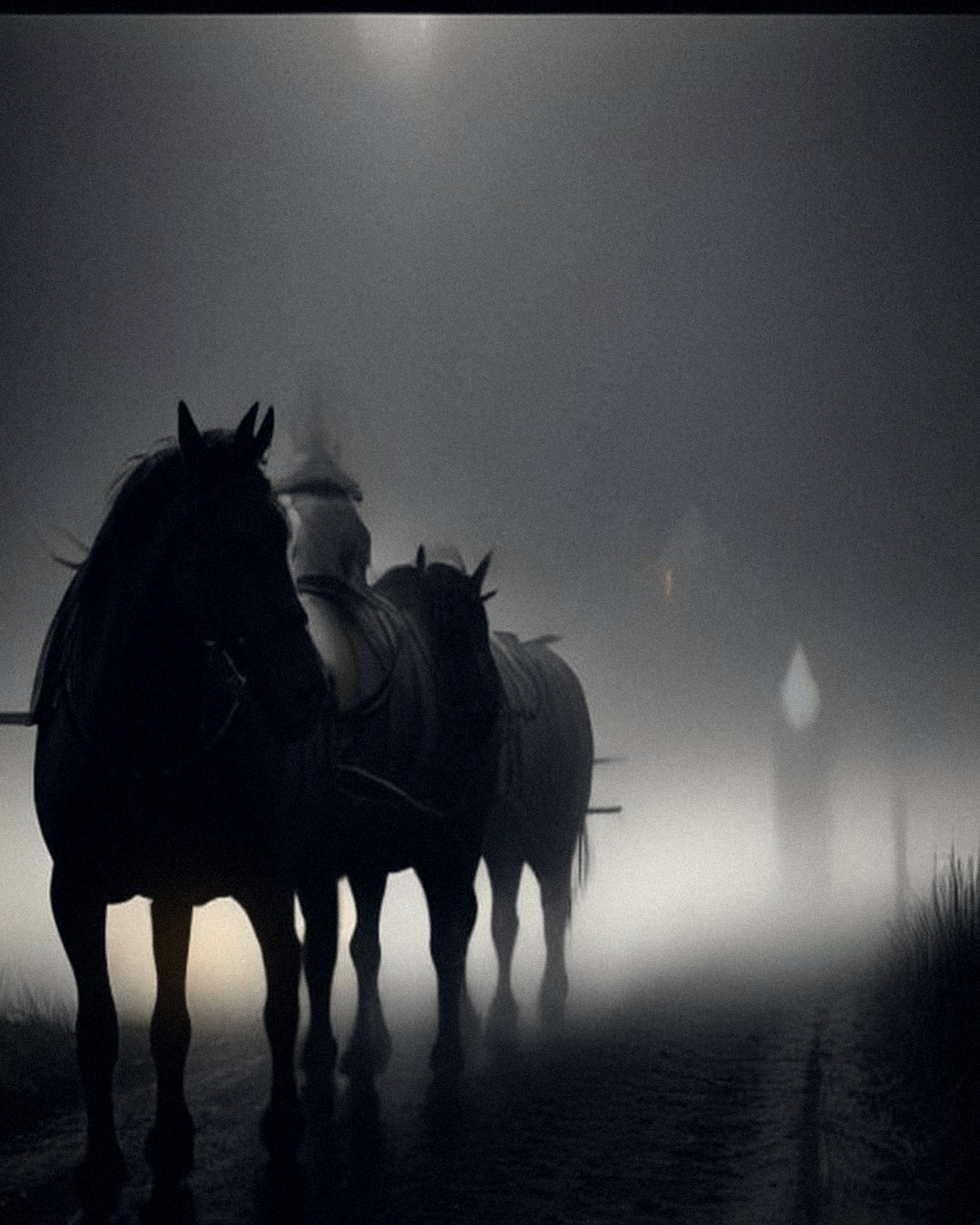
The Dullahan does not always ride alone on horseback. In many parts of Ireland he is said to drive a black funeral carriage known as the cóiste bodhar, usually translated as the “deaf coach” or “silent coach”. It is drawn by black horses, often described as headless themselves, and it moves so fast that the roadside bushes are said to catch fire as it passes. Some say a coffin rides on board. Some say the coach’s wheels and harness are decorated with the remains of the dead.
The rule of the coach is as cruel as the rule of the rider. Once it sets out for someone, it cannot go home empty. If you see the death coach rumbling toward your door, the old warning goes, do not open it, because it has come for whoever answers.
This makes the Dullahan part of a much larger family of death-coach and phantom-carriage tales found across Britain and Ireland, from ghostly carriages heard on manor drives to coaches that roll up at midnight to houses where someone lies ill.
Variants Across the Gaelic World
The rider goes by more than one name. In Irish he is the Dúlachán, a word often said to mean something like “dark man”, and he is also called Gan Ceann, which means simply “without a head”. Some storytellers place him in particular districts and on particular roads, while others treat him as a figure who could appear anywhere a death is due.
Across the sea in the Scottish Highlands, a related headless rider haunts the Isle of Mull. In that legend, a chieftain’s son was beheaded in a clan battle, and his horse carried his headless body away from the field. Ever since, the story goes, the headless horseman and his mount have been heard galloping through the glen when a death is coming to his kin. It is the same idea in a local costume: a rider without a head who arrives as the last messenger.
Further afield, headless riders appear in the folklore of many European countries and, through emigrants, travelled across the Atlantic too. But the Irish Dullahan keeps a sharper edge than most of his cousins. He is not a wandering lost soul looking for his head. He knows exactly where his head is. He is carrying it.
Roots in Older Beliefs
Where did such a figure come from? Nobody can say for certain, but the folklore points backward in some intriguing directions.
The human head held a special place in the beliefs of the ancient Celtic world. It was widely regarded as the seat of the soul and of a person’s power, and carved stone heads survive from that world across Ireland and Britain. A spirit that carries its own head, and uses it to see and to speak names, fits uneasily but powerfully with that old reverence.
Some writers have suggested that the Dullahan is the shadow of something older still: a dark harvest god of pre-Christian Ireland, honoured in ancient times at the turning of the year, whose memory survived as a spirit that rides out and claims lives. When the old faith faded, the theory goes, the god did not vanish. He simply lost his name and kept his appetite. It is a theory rather than a proven history, and we offer it as one possible root among several.
What is clear is that the Dullahan is tied to the dark half of the year. He is said to ride most often around the old festivals, and above all in autumn, as the nights lengthen toward Samhain, the ancient feast at the start of winter when the boundary between the living and the dead was believed to wear thin.
How Belief Shaped Behaviour
Legends like this were never just stories for the fireside. They shaped how people moved through their own countryside.
- Roads to avoid. Some lanes and crossroads carried a reputation, and people preferred not to travel them alone after dark, especially in the autumn months.
- Curtains drawn. At the sound of fast hooves in the night, families kept away from windows and doors rather than risk seeing who was passing.
- A name not to answer. The fear of hearing one’s own name called by an unseen voice on a dark road sits deep in Irish folk belief, and the Dullahan gave that fear a shape.
- Gold in the pocket. The one weakness the stories grant him is gold. The Dullahan is said to fear it, and even a small piece of gold, sometimes no more than a gold pin, is said to be enough to drive him off. People who had to travel at night were advised to carry some if they could.
That last detail is telling. Iron protects against fairies in Irish lore. Gold protects against the Dullahan. He belongs to the same crowded, rule-bound otherworld as the phantom black dogs of the eastern English roads, where every spirit has its own laws and every law has its own small, desperate defence.
Encounters on the Back Roads
The Dullahan is not only a figure from old books. In the countryside his stories are still passed along, usually in the same quiet, half-reluctant way that people share anything they would rather not believe.
The accounts tend to follow a pattern. The hoofbeats. Someone walking home late on an empty road hears a horse coming hard behind them, steps into the hedge to let it pass, and nothing passes. The sound simply runs by in the dark and fades away.
The rider at the crossroads. A figure on a dark horse is glimpsed standing perfectly still where two roads meet, black against the night sky, and something about the shape of its shoulders is wrong. When the witness looks again, the crossroads is empty.
The coach that should not be there. A dark carriage is seen moving along a lane where no carriage has run in living memory, travelling fast and making no sound at all.
The news that follows. Most chilling of all are the stories in which a sighting is followed, days later, by a death in a nearby house. The teller rarely claims the two are connected. They simply set the facts side by side and let the listener draw the line.
We cannot verify names or dates for these encounters, and we will not invent them. We tell them as they are told. What matters to an investigator is the consistency: the same sounds, the same silence, the same sense of something passing that was going somewhere else, for someone else.
Why the Story Endures
The headless horseman has galloped out of Irish folklore and into the wider world, where he has been retold so often that many people know the image without knowing where it came from. But the Irish original remains stranger and harder than any of his descendants.
Part of his power is his purpose. Many ghosts are confused, lost or trapped. The Dullahan is none of those things. He is an errand of death on horseback, punctual and unstoppable, and that makes him the purest form of a fear every human culture shares: that our time is already written somewhere, and that one night someone will ride out to tell us.
He also belongs to a small family of omens that this blog keeps returning to: the banshee’s cry, the black dog on the road, and the Flying Dutchman glowing through the spray off the Cape. Each of them is a warning that arrives from the dark, and each of them has outlived the age that first imagined it.
The Rider Still Abroad
Is the Dullahan simply the way rural Ireland once gave shape to death, a dark rider standing in for every sudden loss that no one could explain? Perhaps. But that has never fully accounted for the people who swear they heard the hooves.
So the file stays open. On the long autumn nights, when the mist lies along the stone walls and the year turns toward Samhain, some still keep a scrap of gold in their pocket on the back roads, and still draw the curtains when a horse comes galloping through the dark. Nobody wants to look up and see who is riding, or to hear their own name called out in the night.
If the headless rider on the death road has you thinking about turning legends like this into your own ghost mystery novel, Ghost Mystery Writer is a downloadable library of 456 prompts for writing complete ghost mystery novels with a free AI chat assistant, built for people who self-publish on Amazon.
Leave a Reply