
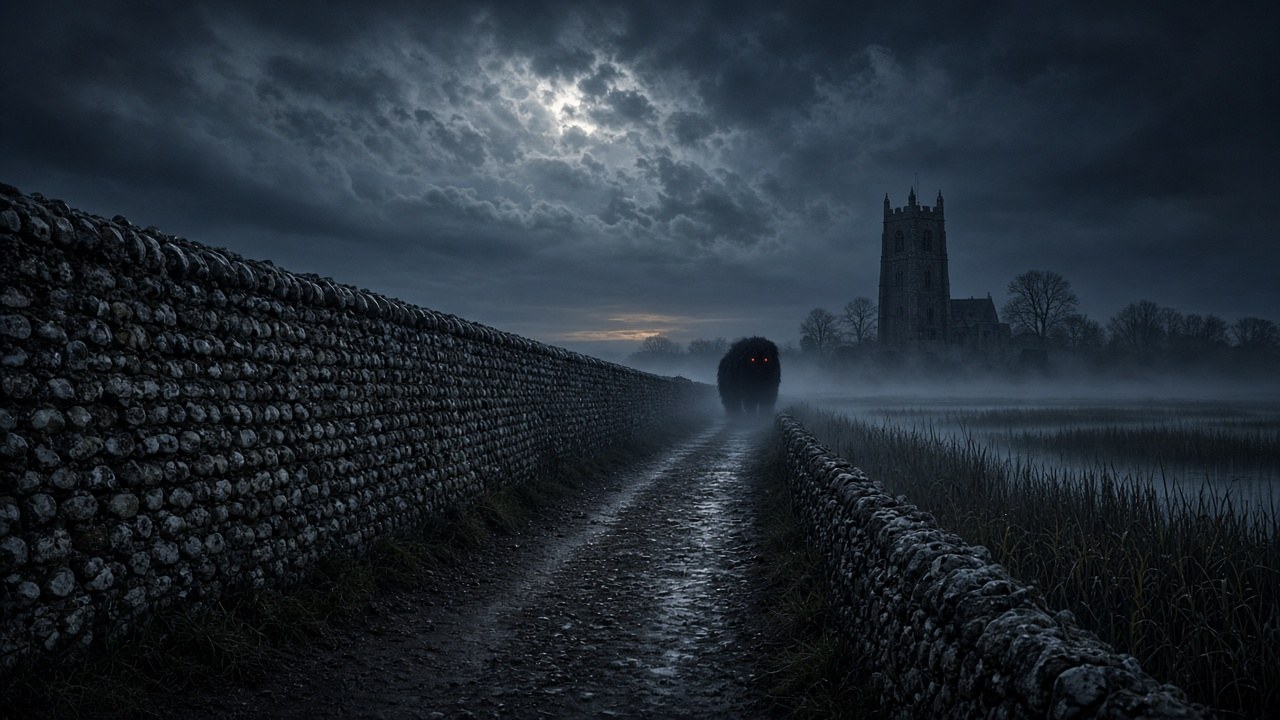
A field report on the phantom black dog of Norfolk and Suffolk: eyes like burning coals, padding footsteps on the coast road, and a storm in 1577 that left its mark on a church door.
This article contains affiliate links; Italian Ghost Hunters may earn a commission if you buy through them.
Some ghosts wait in a room for you to find them. Black Shuck finds you. Along the flat, wind-scoured country of East Anglia, where the marshes run grey into the North Sea and the church towers stand like lighthouses over the fields, people have spoken for centuries of a dog that is not a dog. It is black, shaggy and far larger than any farm animal should be. Its eyes burn red or green. It pads beside lonely walkers on the coast road, keeps pace with them through the dark, and then is simply not there. Some say to see it is to die within the year. Others say it walks you safely home. For investigators, that double face is where the file begins.
Like the banshee who cries outside an Irish door before bad news, Black Shuck belongs to the old family of omens: spirits that do not haunt a building so much as a moment, the last mile home, the hour before the storm breaks. On the back roads of Ireland, that same dread takes the form of the Dullahan, the headless rider whose silent coach stops at the door of the dying.
The Phantom Black Dog Legend as It Is Told
The core of the tale is remarkably steady across Norfolk, Suffolk and the edges of the Cambridgeshire fens. A traveller is out after dark, usually alone, usually on a coast path, a churchyard lane or a raised road across the marsh. They become aware of footsteps that match their own. Sometimes there is breathing, heavy and close. When they turn, they see the hound: as big as a calf in some tellings, as big as a horse in others, with a rough black coat that seems to drink the light.
The eyes are the detail witnesses return to. They are described as glowing like coals, or as large as saucers. In some accounts the creature has a single eye set in the middle of its head. In the strangest versions it has no head at all, and yet the eyes still burn where the head should be. It rarely barks. When it does make a sound, tellers speak of a howl that carries across the marshes and chills anyone who hears it.
What happens next depends on who is telling the story. In the darker version, the hound is a death warning: to meet its gaze is to see your own end coming, for you or for someone close to you. In the gentler version, it is a guardian of the road, a shadow that walks beside a lone traveller until they reach their door and then fades away. Neither version cancels the other. East Anglian households have carried both for a long time.
Regional Variants
Black Shuck is the East Anglian name for a figure that turns up across the British Isles, and each region has given its hound a different temper.
In Suffolk the name sometimes softens to Old Shock. In Yorkshire and the north of England, tellers speak of the barghest, a monstrous dog tied to death and disaster, and of the gytrash, a spectral hound that haunts lonely roads. Padfoot, another northern spirit, is known by the soft sound of its paws and the dragging of a chain. The church grim is a guardian hound said to keep watch over a churchyard, protecting the dead from those who would disturb them. On the Isle of Man, the Moddey Dhoo is a black dog long said to haunt Peel Castle, and its story carries a warning about what happens to anyone foolish enough to follow it alone. In Wales, the Cŵn Annwn are hounds of the otherworld whose baying on the wind is heard before a death.
The pattern is clear even when the details shift. A great black dog. A lonely road, a churchyard, a castle passage. Eyes that shine when nothing should shine. And a message that most people would rather not receive. Like Il Munaciello in the alleys of Naples, the hound is a folk spirit with two faces, and the tellers have never settled which one it will show.
Historical Roots and the Bungay 1577 Storm
The name itself is old. Many folklorists connect Shuck with the Old English *scucca*, a word for a demon or devil. Others hear in it the local dialect word for something shaggy or rough-coated. Both readings fit the creature well, and the file need not choose between them.
Some tellers go further back and trace the hound to the Norse settlers who came to this coast more than a thousand years ago, carrying tales of great dogs and the gods they served. That connection is often repeated and hard to prove, but it would explain why the legend clings so tightly to the shoreline, the river mouths and the low ground where those settlers first landed.
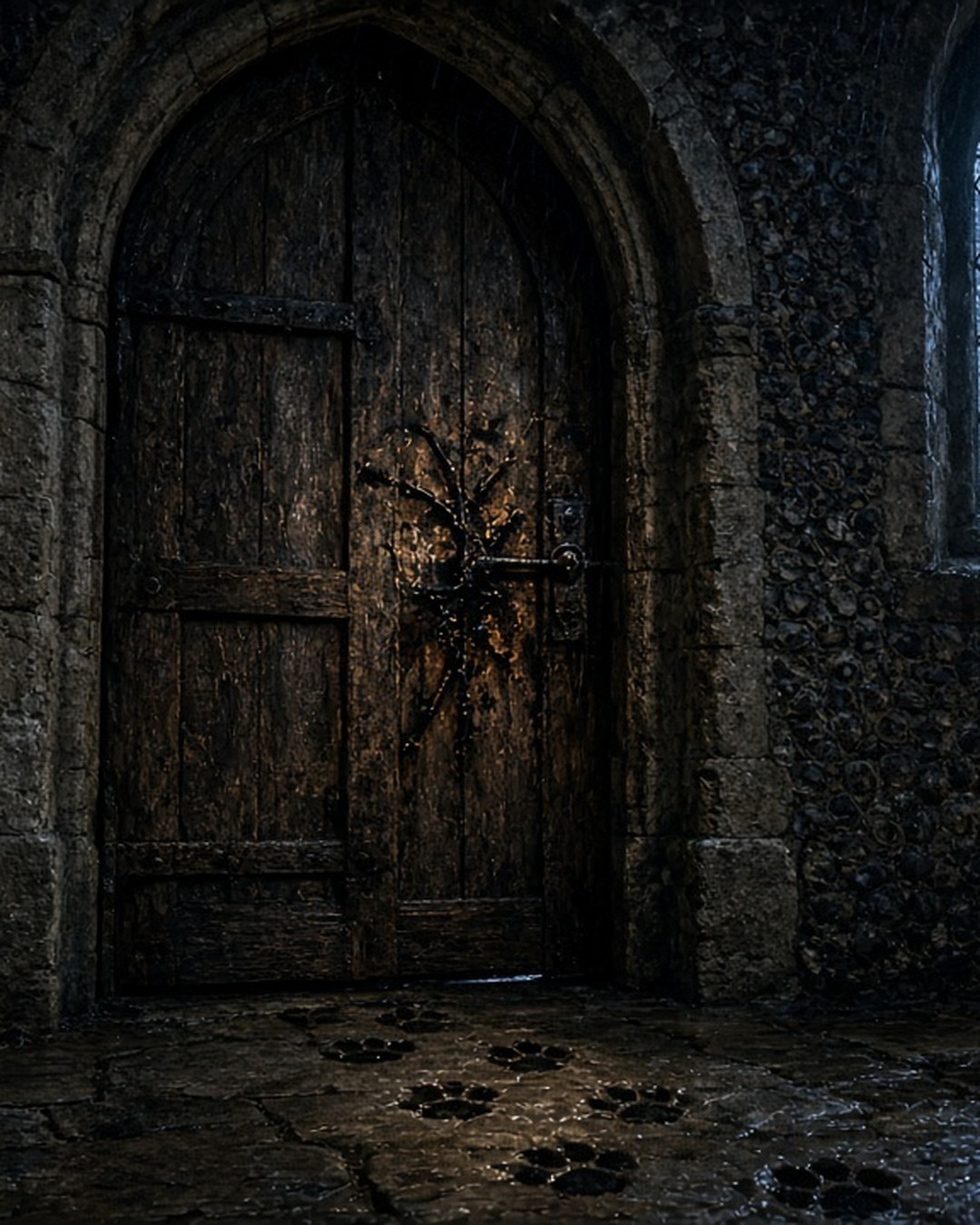
The most famous date in the hound’s history is 4 August 1577. That Sunday, a violent thunderstorm broke over the Suffolk towns of Bungay and Blythburgh while people were at worship. A pamphlet printed soon afterwards described how a black dog, or the devil in its shape, rushed through the church at Bungay in the middle of the storm, and how worshippers died where they knelt. At Blythburgh, the account continues, the creature appeared again: the steeple came crashing down through the roof, people in the congregation were killed, and the hound fled through the north door, leaving it scorched.
Those marks are still there. Visitors to Holy Trinity Church at Blythburgh can see the dark scars on the old north door that local people have long called the devil’s fingerprints. Bungay, for its part, made the black dog part of its civic identity: the creature, often shown with a bolt of lightning, appears on the town’s weathervane and emblem. Few legends have left such a visible signature on real buildings.
How Belief Shaped Behaviour and Places
Belief in Black Shuck has never been purely a fireside entertainment. It shaped how people moved through the landscape after dark. Coast paths, churchyard lanes and the raised causeways over the marshes became places to cross quickly, and preferably not alone. Generations of East Anglian children grew up being told not to linger on certain roads at night, and to be wary of meeting the eyes of any large black dog they did not know.
Churchyards took on a double meaning. If the black dog was a demon, the churchyard was where it might lie in wait. If it was a church grim, a guardian, then it was there to keep worse things away from the dead. Either way, the hound gave the old flint churches of the region an extra weight after sunset, and travellers who passed them at night carried the story with them.
The 1577 storm turned the legend into a matter of record, and of memory. A door that still bears scorch marks, a town that still flies the dog on its weathervane, a date that still gets told on stormy August evenings: these are the ways a community keeps an encounter alive long after the last witness has gone.
East Anglia is no stranger to haunted ground. Just across the Suffolk border in Essex stood Borley Rectory, once called the most haunted house in England. But where Borley’s ghosts kept to one house and one churchyard, Black Shuck roams the whole coast.
Modern Sightings as Real Encounters
The legend has not stayed in the sixteenth century. Reports of the black dog continue to surface, and they share a striking consistency with the older tales.
Walkers on the north Norfolk coast, around Cromer and the cliff paths beyond it, have described being followed on dark evenings by something large keeping pace in the shadows: the soft thud of heavy paws, the sense of a big animal breathing just out of sight, and nothing there when they finally dared to turn. Drivers crossing the fens at night have spoken of a black shape at the edge of the headlights, bigger than any dog they knew, standing perfectly still on the verge and gone in the mirror a second later. Others describe only the eyes: two points of red light low in a hedge, watching, and no animal to be found in the morning.
Some encounters are told as warnings fulfilled. A family hears of the hound on the lane, and soon afterwards bad news arrives. Others are told as quiet kindnesses: a woman walking home alone on a winter night is accompanied the whole way by a silent black dog that vanishes at her gate. Witnesses rarely agree on what the creature wants. They agree, again and again, on what it looks like.
In recent years, archaeologists working at a ruined abbey in Suffolk uncovered the bones of a very large dog, and the local press could not resist the name. Whatever those bones were, they did not settle anything. The sightings on the coast road did not stop.
Why the Story Endures
Black Shuck endures because East Anglia is the kind of country that makes room for him. The land is flat and the sky is enormous. On a moonless night the marsh and the sea blur together, and a single black shape on a single empty road is impossible to ignore. Old churches stand alone among the fields. Fog rolls in off the water with little warning. It is a landscape built for being followed.
He also endures because he refuses to be one thing. A demon that burned a church door. A guardian that walks the lonely home. An omen of death. A faithful shadow. Each generation finds the version it needs, and none of them has ever been proved wrong. Like the phantom drumming that once shook a Wiltshire household in the Drummer of Tedworth case, the black dog of 1577 reached the public through printed pages in its own century, and it has never quite left the page or the road since. Out at sea, sailors tell of another wandering spirit that can never rest, the Flying Dutchman legend of a ghost ship doomed to sail off the Cape of Good Hope forever.
And he endures because the encounters keep coming. The pamphlet of 1577 is not the last word. The scorch marks on the Blythburgh door are not the end of the story. Somewhere on the coast tonight, a walker will hear paws behind them that match their stride, and they will have to decide whether to turn around.
If you ever walk those roads after dark, go with respect. Keep to public paths, leave churchyards as you found them, and if you hear something heavy padding beside you in the fog, remember that the old tales never agreed on whether it comes to warn you or to walk you home. Nobody has ever fully explained what it is.
The file on Black Shuck has never closed. On the right kind of East Anglian night, with the wind off the sea and the church tower black against the clouds, the eyes in the hedge are still watching.
If the great black dog of the coast road has you thinking about turning legends like this into your own ghost mystery novel, Ghost Mystery Writer is a downloadable library of 456 prompts for writing complete ghost mystery novels with a free AI chat assistant, built for people who self-publish on Amazon.
Leave a Reply