
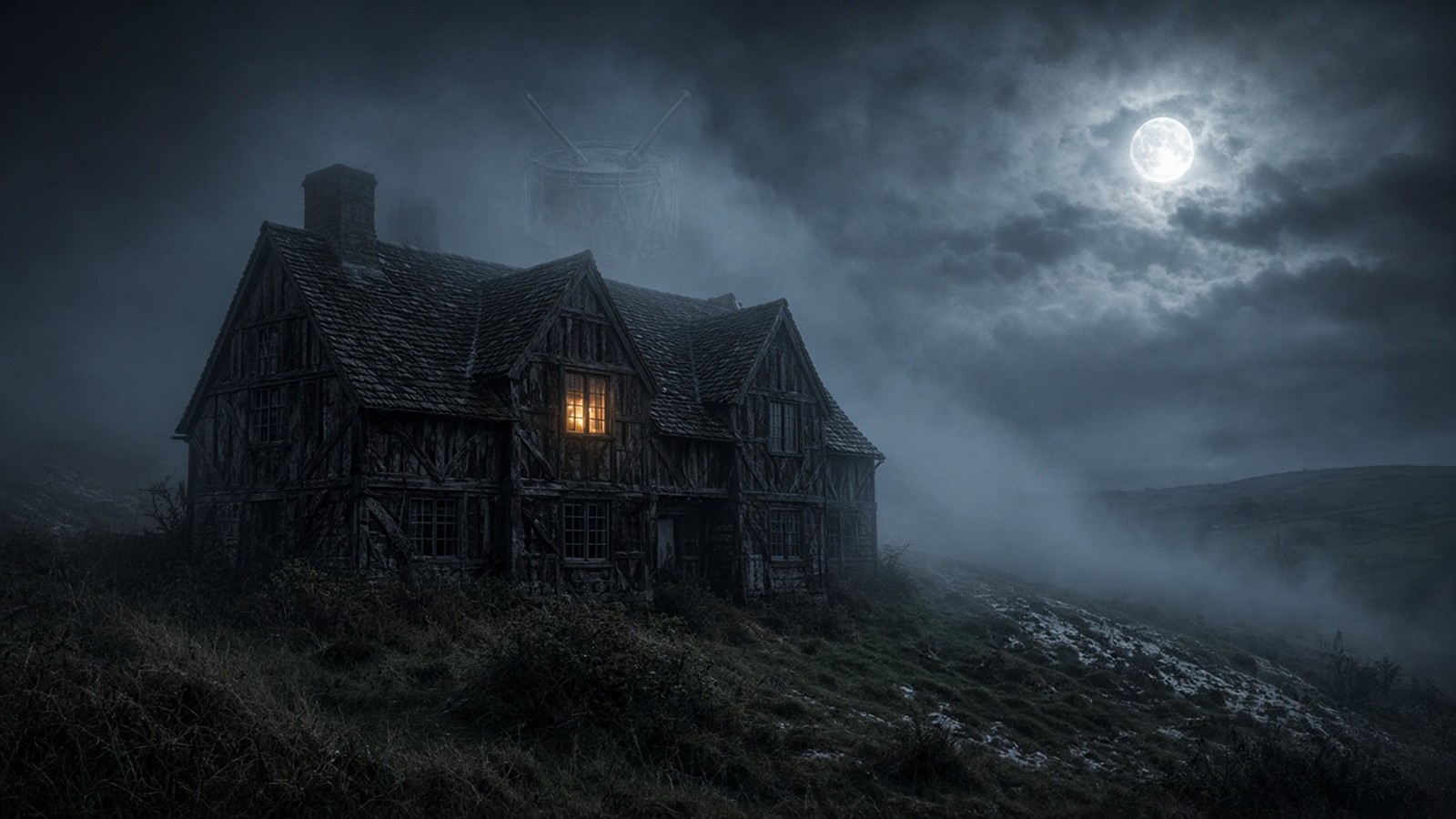
A field report from the Restoration record: a confiscated drum, two years of night drumming in a Wiltshire manor, a witchcraft trial at Salisbury, and a disturbance no one ever explained away.
This article contains affiliate links; Italian Ghost Hunters may earn a commission if you buy through them.
On the edge of Salisbury Plain, where the chalk downs roll out under a wide, pale sky, there stood in the early 1660s a gentleman’s house built largely of board. Then, one spring night, someone began beating a drum on its roof. No drummer could be found. The drumming came back the next night, and the next, and for the better part of two years it never really left. Soldiers’ tattoos rolled through the bedrooms. Beds rose under sleeping children. The Drummer of Tedworth, also remembered as the Tedworth or Tidworth poltergeist, is one of the best-documented hauntings of seventeenth-century England, and it survives not as a fireside tale but as sworn depositions, government newsbooks, letters and a long eyewitness account that was printed and argued over for decades.
The Period and the Setting: Tedworth, Now Tidworth
Tedworth is the old name of the town now called Tidworth, in Wiltshire. In 1661 England was barely a year into the Restoration. The monarchy had returned after the civil wars, and the roads were full of former soldiers looking for a living, some travelling on passes that entitled them to relief along the way.
According to the principal account, in the middle of March 1661 the master of the house at Tedworth was in the neighbouring town of Ludgershall when he heard a drum in the street. The bailiff explained that a vagrant drummer had been demanding money from the constable on the strength of a pass he suspected was counterfeit. The gentleman examined it, recognised the signatures as forged, took the drum and had the man handed to the constable. The drummer confessed the cheat and begged for his drum back. He was told he would have it if his old commanding officer vouched for him. The drum stayed with the bailiff; the drummer talked the constable into letting him go.
About the middle of April, as the gentleman prepared a journey to London, the bailiff sent the drum to his house. The instrument arrived. Its owner did not.

What the Record Says
When the master came home from London, his wife told him the family had been terrified in the night by what they took for thieves. Within three nights he heard it himself: a tremendous knocking at the doors and on the outside walls. He went round the house with a brace of pistols. Each time he opened a door, the knocking moved to another. When he went back to bed it became a thumping and drumming on the roof, which, in the words of the account, went off by degrees into the air.
The drumming settled into a pattern: usually five nights on, three off, always as the family was falling asleep. After a month outside, it moved into the room where the confiscated drum was kept.
The children’s beds. After the lady of the house gave birth there was a quiet spell of about three weeks. Then the disturbance returned harder and fastened on the youngest children. It beat on their bedsteads so violently that onlookers expected the frames to break. Hands laid on the beds felt no blows, only the wood shaking. For an hour at a time it drummed military calls, among them a tune called “Roundheads and Cuckolds” and the tattoo, as well as any living drummer. Then came scratching under the bed, as if from iron talons. It lifted the children in their beds and followed them from room to room. When they were moved to an untroubled loft and put to bed in broad daylight, it was with them again at once.
The moving board. On 5 November 1662, before a room full of people, a servant saw two boards stir and told the thing to give him one. A board slid toward him and stopped within a yard. He asked for it in his hand, and it came all the way. He pushed it back; it returned, at least twenty times, until the master forbade such familiarities. That evening, as soon as the parish minister finished praying at the children’s bedside, chairs walked about the room and shoes flew over the children’s heads.
Lights, voices and a shape. That winter the family heard singing in the chimney. A blue, glimmering light entered the master’s chamber, and those who looked at it said their eyes went stiff. Maids swore that doors opened and shut before them at least ten times, each time as if half a dozen people had walked in. A voice in the children’s room cried “a Witch, a Witch.” One night a manservant saw a great body at the foot of his bed, its shape impossible to make out, with two red, glaring eyes fixed on him until they vanished.
The visitor’s night. In January 1663 a young clergyman and philosopher, later a royal chaplain and a fellow of the new scientific society in London, rode to the house to see for himself. The drumming had largely ceased, but the scratching around the children had not. He went up with the master and a friend and found it behind the bolster of a bed where two small girls lay, their hands plainly outside the covers. When he pushed his hand behind the bolster, the noise moved elsewhere in the bed, then returned when he withdrew. He scratched on the sheet five, seven and ten times, and each time it answered with exactly his number. He searched the bed to its cords, sounded the wall, and found nothing. Then the noise moved under the children and panted like a dog out of breath, so strongly that the bed pushed up against his hand and the windows shook. Before dawn something knocked at his own chamber door. When he asked in God’s name who was there, a voice answered, “nothing with you.” He was assured no one in the household had been on that landing. In the morning his horse was found in a sweat, as if ridden all night; it fell lame on the way home and died within days. He wrote that he was persuaded then, and still, that something preternatural was at work.
The Trial and the Drummer’s Boast
The drummer did not vanish from the story. In 1663 he was in Gloucester gaol for theft. According to the account, a visitor from Wiltshire came by, and the drummer asked whether he had not heard of the drumming at a gentleman’s house in Tedworth. The visitor said he had heard enough of it. The drummer replied, in substance, that he had plagued the man, and that he would never be at peace until he made satisfaction for taking away the drum.
Historians working from legal records have filled in the rest. At the Gloucester assizes at the end of March 1663 the drummer was convicted of stealing two pigs and sentenced to transportation. Being carried by barge to his ship, he jumped overboard, escaped back to Wiltshire, and bought a new drum. The master of the house then had him indicted under the witchcraft statute. Depositions in the case were printed in the government newsbooks that April; one records that soon after the drum reached the house, an unseen drum began to beat “Roundheads and Cuckolds go dig, go dig,” the note the drummer was known to play and seldom any other, and that the noises went on even after the master burned the drum.
At the Salisbury assizes in August 1663, the parish minister and several respected residents swore to what they had witnessed. The master later wrote that the grand jury found the bill, but the trial jury acquitted the drummer, “not without some difficulty.” The principal account adds the observation the household found most telling: while the drummer was locked up or sent away, the house was quiet, and when he came back at liberty, the disturbance returned.
The Context of the Time
Restoration England was home to a confident new spirit of experiment and to a fashionable scepticism that mocked spirits and witches as relics of a credulous age. The clergyman who visited Tedworth saw the case as evidence in that argument: if spirits could be shown to act in the world, the unseen world was no fable. His relation was first printed in the 1660s and later enlarged in a 1681 treatise on witches and apparitions, where it stood first among his modern proofs.
The case reached the throne. The king sent gentlemen of the court to investigate, and on the night they stayed the house was quiet. Sceptics seized on it. The clergyman answered that the disturbance had always come and gone, sometimes for days or weeks, and that one silent night could not cancel two years of testimony from family, servants, neighbours, ministers and strangers who arrived expecting a trick and left convinced. On Christmas Day 1667, a London diarist recorded his wife reading the story to him, and called it “a strange story of spirits, and worth reading indeed.”
What Later Research Found
The paper trail has held up remarkably well. A historical study published in 2005 traced the episode through letters, newsbooks and legal references, and showed that key details of the account can be checked against independent records: the pass, the drum, the pig theft at Gloucester, the escape from the barge, the witchcraft indictment and the Salisbury acquittal. Tedworth is not a later embroidery. It was written up while the people involved were alive and could be questioned.
Rumours spread that the master of the house had admitted it was all a trick. The family’s answer was set down in the next century by a famous preacher in his journal. His eldest brother had been at Oxford with the master’s son and asked him directly whether his father had ever confessed a fraud. The son said no: the flood of gentlemen visitors had grown so costly that his father simply stopped contradicting the rumour, though he and the whole family knew the published account to be “punctually true.”
Later writers proposed their own solutions, pointing at the drummer’s associates, the servants or the children. Each theory fits a piece of the record. None fits the whole: the drumming on the roof chased by a man with pistols, the board sliding to a servant in daylight, the panting under the visitor’s hand while the children’s hands lay in plain sight, the voice outside a door where no one stood. The scholarship has confirmed the trial. It has never closed the case.
What the Story Tells Us About Its Era
Tedworth shows how a haunting entered the public record in the seventeenth century: a household terror, then local testimony, a witchcraft prosecution, a royal inquiry and a printed controversy. A century later the Cock Lane ghost would travel a similar road, from knocking in a London house to the pages of the city’s newspapers. For the modern investigator, its lessons still hold. Note when a disturbance begins and what arrives with it; here it was an object taken from a man who wanted it back. Note who is present when activity peaks and who is present when it falls silent, a question investigators would ask again centuries later in the Enfield Poltergeist and Rosenheim Poltergeist cases. Copy the witnesses’ own experiments, such as counted scratches and a hand behind the bolster. And remember the clergyman’s warning that one quiet night proves very little against a long run of testimony.
Tidworth today is an ordinary town on the edge of the Plain. The drum was burned long ago, and the drummer slipped out of history somewhere between a prison barge and the colonies. What remains is the record: a drum beating on a roof in the spring of 1661, a board sliding across a floor, a voice in the dark answering “nothing with you.” The Drummer of Tedworth was tried, acquitted and never explained. As far as the archives are concerned, the beat simply stopped.
If old records like this make you want to turn a real haunting into your own ghost mystery novel, Ghost Mystery Writer is a downloadable library of 456 prompts for writing complete ghost mystery novels with a free AI chat assistant, made for people who self-publish on Amazon.
Leave a Reply