
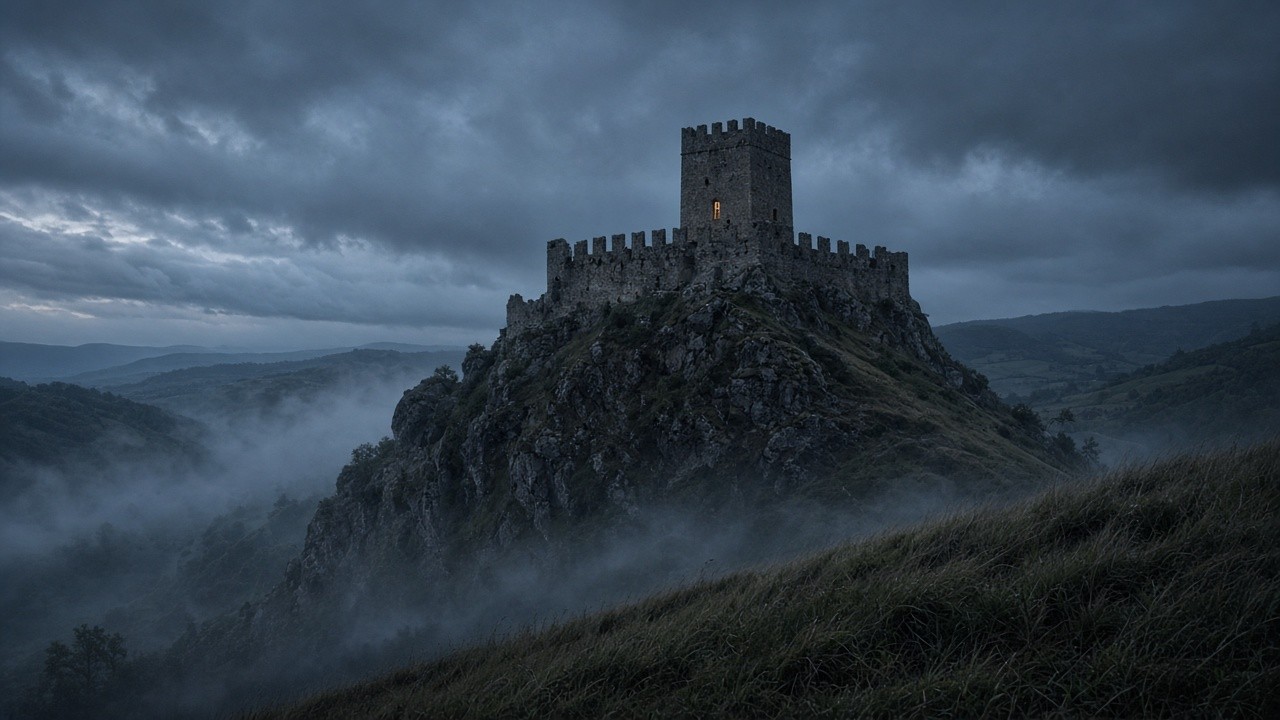
A field report from Castello di Montebello, a hilltop fortress above the Marecchia valley near Rimini, where a little girl with blue-tinted hair went down into the dark on a stormy solstice and, the legend says, never came back up.
Arrival on the Rock
The road climbs out of the plain behind Rimini in tight, patient bends, and the coastal plain drops away behind you until it is only a pale haze. Then the hill narrows to a spine of rock, the houses of the hamlet crowd together as if for warmth, and the castle appears above them: grey stone, a squat tower, walls that seem to grow out of the cliff rather than sit on it. On a clear afternoon it looks like a postcard. On an evening when the clouds roll in from the Apennines and the wind starts working at the shutters, it looks like exactly what it is said to be: a place where something was lost and is still being looked for.
Castello di Montebello is small as castles go. You can cross its courtyard in a few dozen steps. But visitors who come for the view tend to leave talking about something else entirely, because this is the castle of Azzurrina, the child whose voice, according to local tradition, still rises from beneath its floors. Of all the haunted castles of Italy, few have a ghost so specific, so gentle and so stubbornly persistent as the Azzurrina ghost.
Where It Is and How It Came to Be
Montebello is a hamlet in the municipality of Poggio Torriana, in the province of Rimini, Emilia-Romagna. The castle stands on a rocky height between the valleys of the Marecchia and the Uso rivers, the kind of commanding position medieval lords prized: from its walls you can watch the approaches from the coast and from the hills inland. The land around it was fought over for centuries by the rival lords of Romagna, and the castle passed through several hands before settling with the noble family that has kept it for generations and opened it to the public.
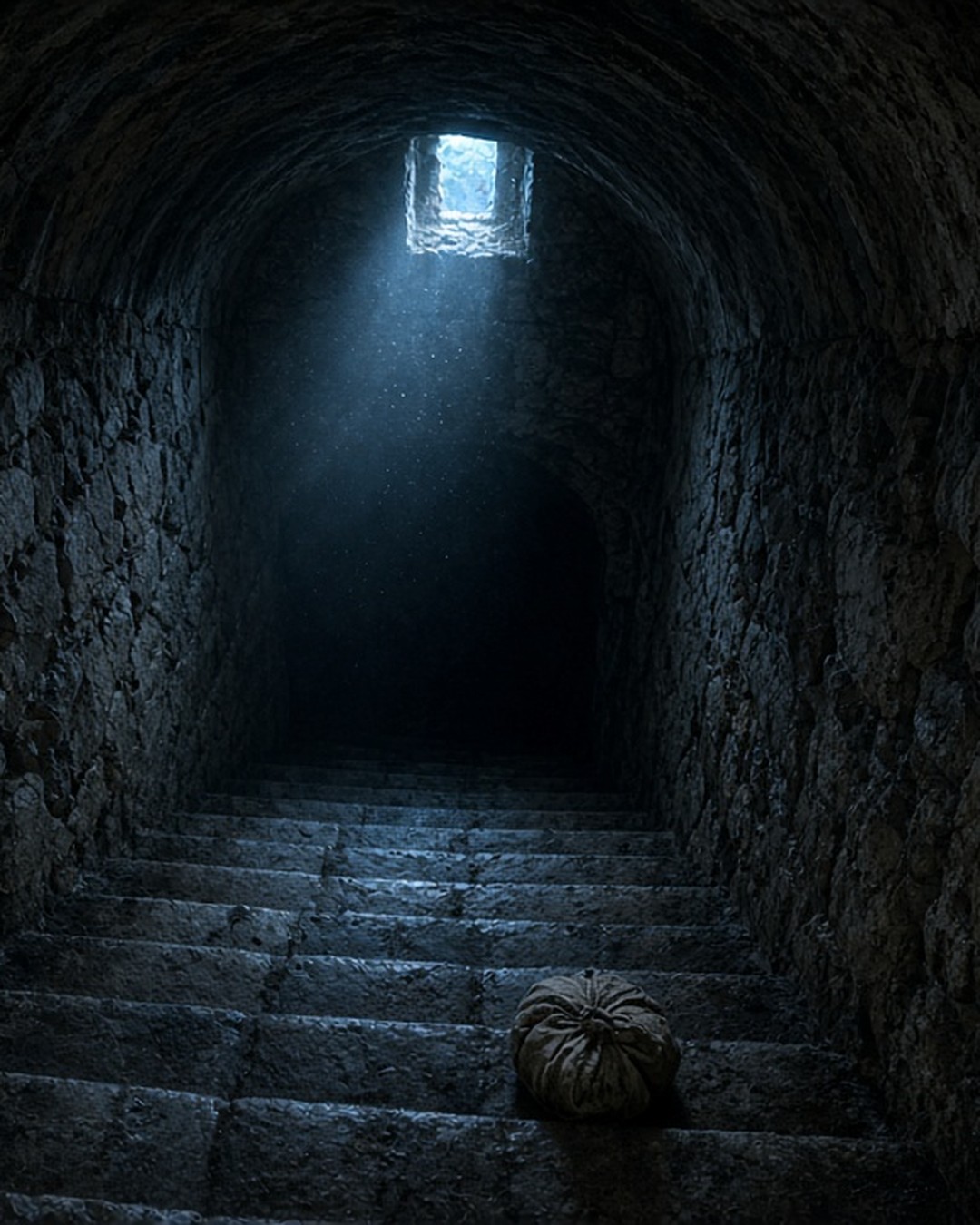
Today the castle is a house-museum. Guided tours lead visitors through furnished rooms, among old furniture and family belongings, and down into the lower levels cut into the hill. It is those lower levels, cold even in summer, that matter most to the story. Somewhere beneath the living rooms lies the space the legend calls the icehouse, a storeroom dug into the rock where ice and food were once kept. That is where the trail of Azzurrina ends.
The Legend of Azzurrina
The story is told on every tour, and it has been told in the valley for a very long time. The legend gives a precise date: 21 June 1375, the summer solstice.
The lord of the castle, the story goes, had a small daughter, often called Guendalina in the telling, who was born albino. Her skin was pale and her hair was white, and in an age when such things could be taken as a mark of witchcraft, her family feared for her. Her mother is said to have tried to darken the child’s hair with vegetable dyes, but the colour would not hold on such fine, pale hair. Instead it took on a strange bluish sheen, and so the girl became known as Azzurrina, the little blue one.
Because she was believed to be at risk, she was rarely allowed out and was watched over by two guards. On that solstice afternoon a violent storm broke over the hill. Azzurrina was playing inside with a ball made of rags. The ball slipped from her hands and bounced away down the stone steps towards the cellars. She ran after it. The guards heard a scream from below and hurried down.
They found nothing. No child, no ball, no body, no trace. The icehouse was a closed space cut into the rock, and still she was gone. The guards, the legend adds, swore they had seen no one come out.
Layers of Belief
What makes Montebello unusual is the way the legend has fixed itself to a rhythm. According to tradition, Azzurrina makes herself heard on the summer solstice, and above all in years that end in a zero or a five, every five years, during storms. The story has gathered the details that give a haunting its shape: the storm, the solstice, the rag ball, the steps going down.
The blue-haired child also carries the older fears of the medieval world into the present. An albino girl hidden away because people might call her a witch is a tragedy before any ghost appears. Many who hear the story feel that her disappearance is the last chapter of a life that was already lived in the shadows, and that the voice under the castle is not frightening so much as unfinished. Like the weeping figure of La Llorona on the riverbanks of Latin America, Azzurrina is a ghost defined by a sound and by loss, and that may be why she has never faded from the valley’s memory.
The Azzurrina Ghost: Reported Phenomena
The voice beneath the floor. The best-known claim at Montebello is that a child’s voice, crying, laughing or calling out, can be heard in the lower rooms on the solstice. Recordings said to have been made in the castle over the years are played to visitors, and people who have heard them describe faint sounds that seem to rise and fall through the noise of the storm: something like a sob, something like a child’s laughter, something like a word just out of reach. What they actually contain is still argued over, and the people who made them have never claimed to explain what they captured.
The storm that comes on cue. Visitors and locals alike remark on how often the legend’s weather seems to arrive. The solstice storm is part of the story, and witnesses who have waited in the castle on those nights speak of the air changing, of thunder rolling down the valley, and of the uneasy sense that the house was waiting with them.
Footsteps on the stairs. Some who have stood near the steps to the lower levels describe the sound of small, quick feet, as though someone were running down after something that had rolled away. No one is ever there.
The cold room. The icehouse is cold by design, but visitors often say the cold there feels different: sudden, close, concentrated in one spot and then gone. Some report the feeling of a light touch, or of a small hand, in the dark.
The ball. In a few accounts passed along by visitors, people have glimpsed or sensed something small moving across the stone, or have heard what sounds like a soft object bouncing down the steps. It is the most delicate of the reports and, for many, the most unsettling.
Investigations and What Went Wrong
The recordings have done more than anything else to make Montebello famous, and they have drawn amateur investigators, curious tourists and night-time visitors to the solstice. Over the years the castle has hosted visitors who came with microphones and cameras hoping to catch the voice for themselves, and the story has travelled far beyond Romagna through articles and broadcasts.
As at every famous site, the attention has not always helped. A handful of recordings played in a guided tour cannot carry the whole weight of a haunting, and a crowded room on a solstice night is a poor place to listen for something faint. Investigators who have spent time here tend to agree on one thing: the storm, the old stone and the excited voices of other visitors make clean evidence very hard to gather. Some listeners hear wind and the creak of the building in the recordings. Others hear a child. Neither side has been able to make the other unhear it.
Historians point out that the legend is carried by tradition rather than by any record that visitors are shown, and that the details of Azzurrina’s family have been told in different ways. That has not loosened the story’s hold. A legend does not need a document to be true to the people who have stood at the bottom of those steps and listened.
If You Are Going
Castello di Montebello is a private home and museum, and the descent to the lower levels is part of the guided tour rather than a place to wander alone. If you want to investigate, do it with care and with permission.
- Book a visit through the castle. Check the official opening times and any special evening or solstice visits directly with the castle before you travel. Do not try to enter outside opening hours.
- Respect the house. People live with this story and care for these rooms. Touch nothing you are not invited to touch and follow the guide’s directions on the stairs, which are old, steep and uneven.
- Record quietly. If audio recording is allowed, place your recorder away from the group, note the time of every loud noise around you, and log the weather. A careful log is what turns a strange sound into evidence worth sharing.
- Mind the storm. Solstice storms are part of the legend and also a real hazard on an exposed hilltop. Drive the hill roads slowly and plan your way down in the dark.
- Treat Azzurrina kindly. Whatever remains here is, in the story, a frightened child. Speak to her gently if you speak at all, and never mock or provoke.
- Explore the region. Romagna and Emilia are rich in haunted strongholds. Our guide to haunted castles in Italy you can sleep in includes castles in Emilia-Romagna that welcome overnight guests.
What the Castle Keeps
Strip away the tour, the souvenirs and the solstice crowds, and Castello di Montebello is a family home on a rock, holding on to the memory of a child it lost. Like Poveglia in the Venetian lagoon, it is a place where Italian history and grief have soaked into the stone until the two can no longer be told apart. And it is not the only Italian castle said to keep a lost child: at Castello di Fumone in Lazio, visitors still speak of a little marquis whose cries are heard in the rooms where he once played.
The legend asks for very little. It does not promise a figure in the window or a face in a photograph. It promises only a sound: a child calling from somewhere below, on one stormy night every few years, from a room where no child should be. Generations of visitors have gone down those steps to listen. Some come back up shaking their heads. Others come back very quiet and will tell you, if you ask, that they heard her.
Where Azzurrina went on that solstice afternoon, nobody has ever said. The icehouse is still there. The steps still lead down. And every five years, when the thunder rolls over the Marecchia valley, someone is waiting in the dark for the little blue one to answer.
Leave a Reply