
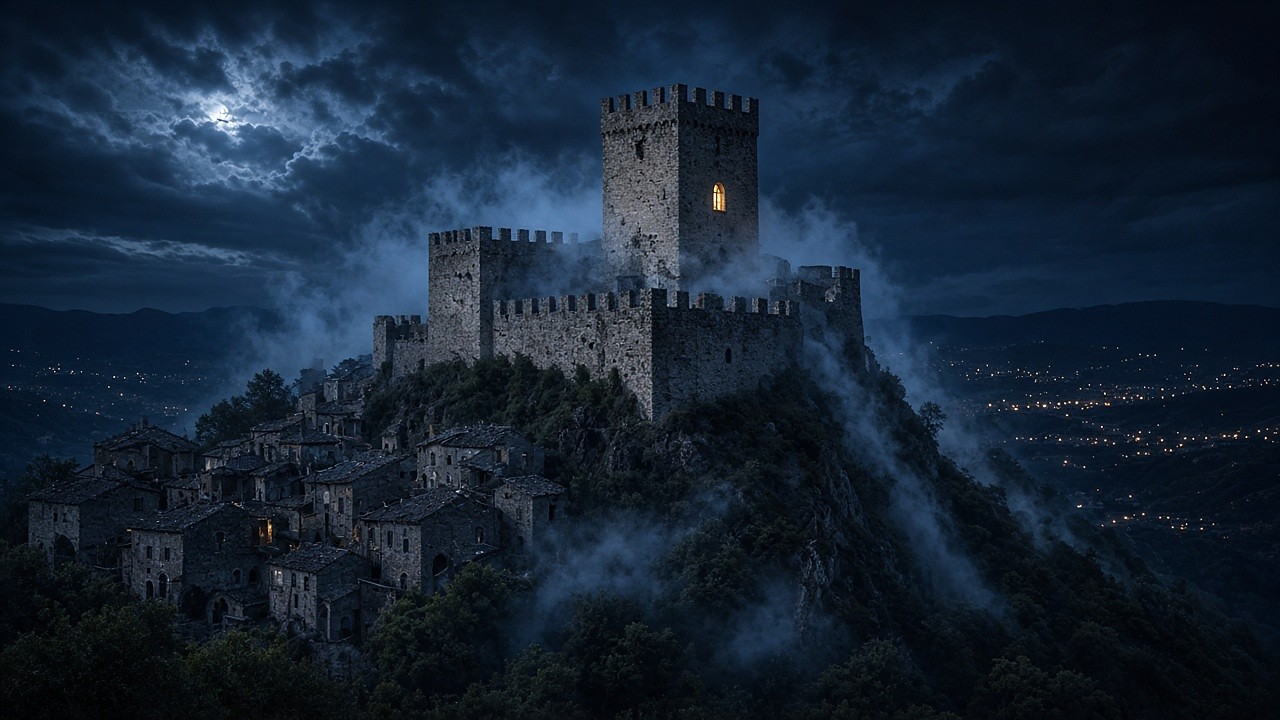
A field report from a fortress above the Ciociaria: a haunted castle in Lazio where a hermit pope ended his days in a stone cell and a grieving mother’s love, the legend says, never let her little boy leave.
The Village That Sends Up Smoke
You see the hill long before you reach it. It rises out of the green country of southern Lazio like a raised fist, steep on every side, and at its very top the village of Fumone sits wrapped around its castle, the houses pressed against the walls, the walls pressed against the sky. On a clear morning you can look out from the ramparts across a wide sweep of valleys and lesser hills. On an autumn evening, when cloud settles on the summit and the lanes go quiet, the place seems to float, cut off from everything below, and you begin to understand why so many people who climb up here say the castle feels occupied.
Fumone is not a ruin. It is a lived-in house, furnished, cared for and full of objects, and that is part of what makes it unsettling. Its ghosts are not knights or nameless prisoners lost to the centuries. The one everyone asks about is a child, and the other is his mother, and visitors who walk through their rooms often say the grief there feels recent.
A Fortress Built for Watching
Fumone stands in the province of Frosinone, in the historic area of Lazio known as the Ciociaria, between Rome and the mountains to the south-east. The hill was a natural lookout, and for centuries the fortress on its summit served as a sentinel for the lands around it. Its name is usually tied to smoke: when enemies were seen approaching, fires were lit on the heights and the column of smoke warned the countryside, and the warning could be passed from hill to hill. An old saying still repeated in the area holds that when Fumone smokes, the whole countryside trembles.
The castle’s most famous historical prisoner gave it a darker reputation. In the last years of the thirteenth century an elderly hermit who had been elected pope, and who had then renounced the papal throne after only a few months, was brought here and held under guard. He died in the fortress in 1296. Visitors are still shown the cramped cell said to have been his, a space so small that many who step inside come out quieter than they went in.
Centuries later the castle passed to a noble family, whose descendants still own it and have opened it to visitors. Over generations they turned the fortress into a home, with furnished apartments, family portraits and a garden laid out high on the castle’s upper levels, one of the strangest and loveliest sights in Lazio: trees and hedges growing on top of a fortress, with nothing beyond them but air.
Il Marchesino: The Legend of the Little Marquis Ghost
The story told most often at Fumone belongs to the nineteenth century and to the family who lived there. It is told on the guided tours, it is told in the village, and the details shift a little with each teller, but its heart never changes.
The family, the legend says, had many daughters and longed for a son who would carry on the name and inherit the estate. At last a boy was born, and he was adored. The household called him the little marquis, il marchesino. But his arrival changed everything for his older sisters, whose own futures, and whose shares of the family fortune, now seemed to shrink. The boy grew sickly. He weakened and died while still a small child.
In the version told most often, his death was no accident. The sisters, it is said, had been slowly poisoning him, a little at a time, so that his decline would look like illness. Whether that is what truly happened, no record shown to visitors can say. The legend is certain, though, about what came next.
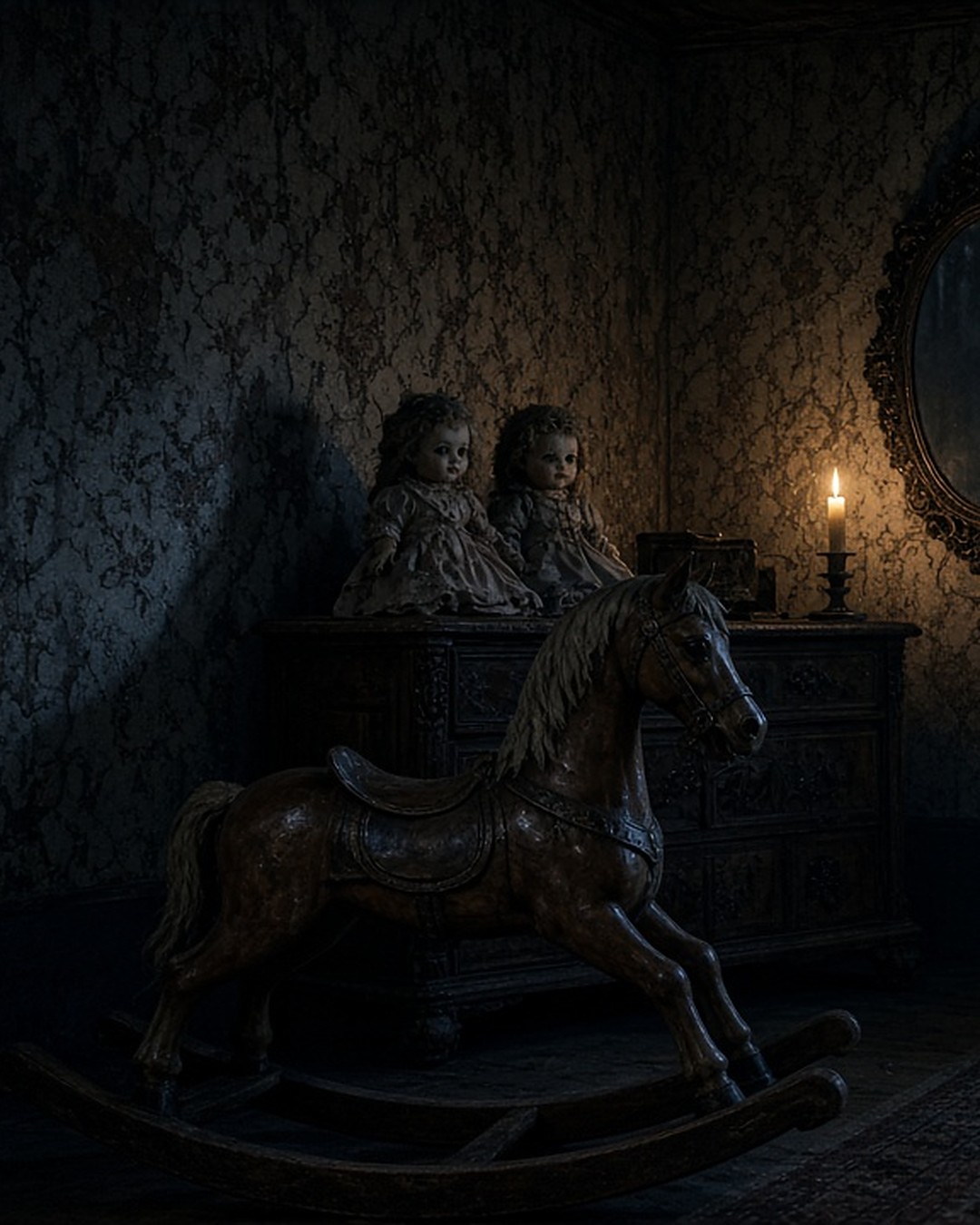
His mother could not bear to let him go. She had the child’s body preserved and kept him at the castle, in a room filled with his clothes, his toys and his little belongings, and she is said to have spent the rest of her life in mourning, dressed in black, with the house around her darkened by her grief. The boy’s room and its relics remain part of the castle visit to this day, and people who have stood in it describe a silence unlike anywhere else in the house.
Layers of Belief
Fumone’s haunting draws on two very old fears at once. The first is the fear of what families can do to one another when inheritance is at stake, a story told in noble houses all over Italy. The second is the fear of a grief so strong that it refuses the natural order of things and keeps the dead in the world of the living. In southern Italian tradition the line between the household and its dead has always been thin. Just as Naples tells of Il Munaciello, the little spirit who lives among a family’s rooms, Fumone tells of a child who never really left his.
There is also the shadow of the imprisoned pope. Local belief has long treated the castle as a place marked by suffering, and many visitors arrive already braced for something heavy in the air. For some, the old cell and the child’s room are two halves of the same story: a fortress where people were kept, whether by force or by love, and never quite released.
The Reported Phenomena
The crying child. The most persistent claim at Fumone is that a child can be heard weeping or calling out in the castle, especially at night and especially near the rooms linked to the little marquis. People who say they have heard it often describe the sound as coming from just beyond the next doorway, and stopping the moment they go to look.
The woman in mourning. Visitors and villagers tell of a woman’s figure, dark-clothed, glimpsed moving through corridors and across the upper rooms, sometimes accompanied by the sound of quiet sobbing. In the stories she is the marchioness, still walking the house, still unable to rest. Some accounts place her in the garden at dusk, looking out over the valleys.
Footsteps and small noises. Guides and guests pass along reports of light footsteps in empty rooms, as if a small child were running through the apartments, and of the soft sounds of play: something knocked, something rolling, a door moving on its own.
Toys that do not stay put. In some of the accounts that circulate about the castle, objects in the child’s room are said to be found slightly moved, as though someone had been playing with them. It is a common motif in haunted houses with a lost child at their centre, and at Fumone it is told with particular tenderness.
The weight in the cell. The tiny cell associated with the hermit pope is not usually said to hold a ghost, yet many visitors describe a pressure there, a sense of being watched or of not being alone, that fades only when they step back into the light.
The cold rooms. As in many old stone buildings, sudden pockets of cold are reported in particular rooms. At Fumone people tend to mention them in the same breath as the child, saying the chill arrives just before the crying starts. Old walls and draughts could account for some of it, but those who have felt it rarely describe it as a draught.
Investigations and What Went Wrong
Fumone has become one of the best-known haunted castles in central Italy, as storied in its own way as Poveglia in the Venice lagoon, and that fame has drawn amateur investigators, ghost-tour groups and curious travellers who come hoping to hear the child for themselves. The castle has welcomed visitors on its own terms, through guided tours and occasional special evenings, and the family’s openness about the legend is a large part of why it has survived so vividly.
As at every famous haunted site, popularity has brought its own problems. Stories travel and grow in the retelling, and some versions of the legend that circulate online add details that the castle itself does not claim. The most common mistake investigators make here is to treat the preserved child and his room as a stage for a performance, which is both disrespectful and useless as evidence. Excited groups, flashlights, chatter and a dozen recorders running at once make it almost impossible to say what anyone actually heard.
Historians, for their part, note that the poisoning story rests on family tradition rather than on any document visitors are shown, and that the story may have taken its sharpest edges from the way such tales are told. None of that touches the testimony of those who say they have heard a child crying in a house where no child lives. Those accounts remain where they began: unexplained.
If You Are Going
Castello di Fumone is a private residence and a museum. The rooms connected to the legend are visited with a guide, and the family’s home and the child’s memory deserve respect.
- Visit through the castle. Check opening times and any evening or special visits directly with the castle before you travel. Never try to enter outside opening hours or climb into closed areas.
- Treat the child’s room as a memorial. Speak quietly, follow the guide’s instructions about photography, and do not try to provoke a reaction. You are standing in a family’s grief, not a haunted attraction.
- Record with discipline. If recording is allowed, use one device, keep it still, and log every sound around you as it happens: footsteps of other visitors, doors, voices from the village, wind. A clean log is what lets a strange sound stand on its own.
- Note the weather and the hour. Fog and wind are frequent on the summit and change the acoustics of the stone rooms. Write down conditions so you can compare visits.
- Go slowly in the village. The lanes are steep and the drive up the hill is narrow and winding. Plan your descent in the dark, and respect the residents, who live with the legend every day.
- Combine your trip with care. If you are touring haunted Italian fortresses, pair Fumone with the other haunted castles in Italy you can sleep in, or with Castello di Montebello, where another lost child is said to call from beneath the floors, or head north to Villa de Vecchi above Lake Como, where a vanished daughter and a grieving count are said to linger in an abandoned mansion.
What Fumone Really Is
Strip away the tours and the online retellings, and Fumone is a house that has kept faith with its dead. A hermit pope ended his life within these walls. A family lost a beloved son and refused to let his memory leave the rooms where he played. For centuries the fortress watched the valleys for danger; now it seems to watch over the people it kept.
Whether the crying in the night belongs to a little marquis who never left, to a mother who still searches for him, or to something stranger still, no one who has heard it has been able to say. The family keeps the rooms. The village keeps the story. And on foggy evenings, when the hilltop floats above the Ciociaria and the lanes fall silent, visitors still stop in the corridors and listen, waiting for a sound that may come from the next room, and may not come from this world at all.
Leave a Reply