
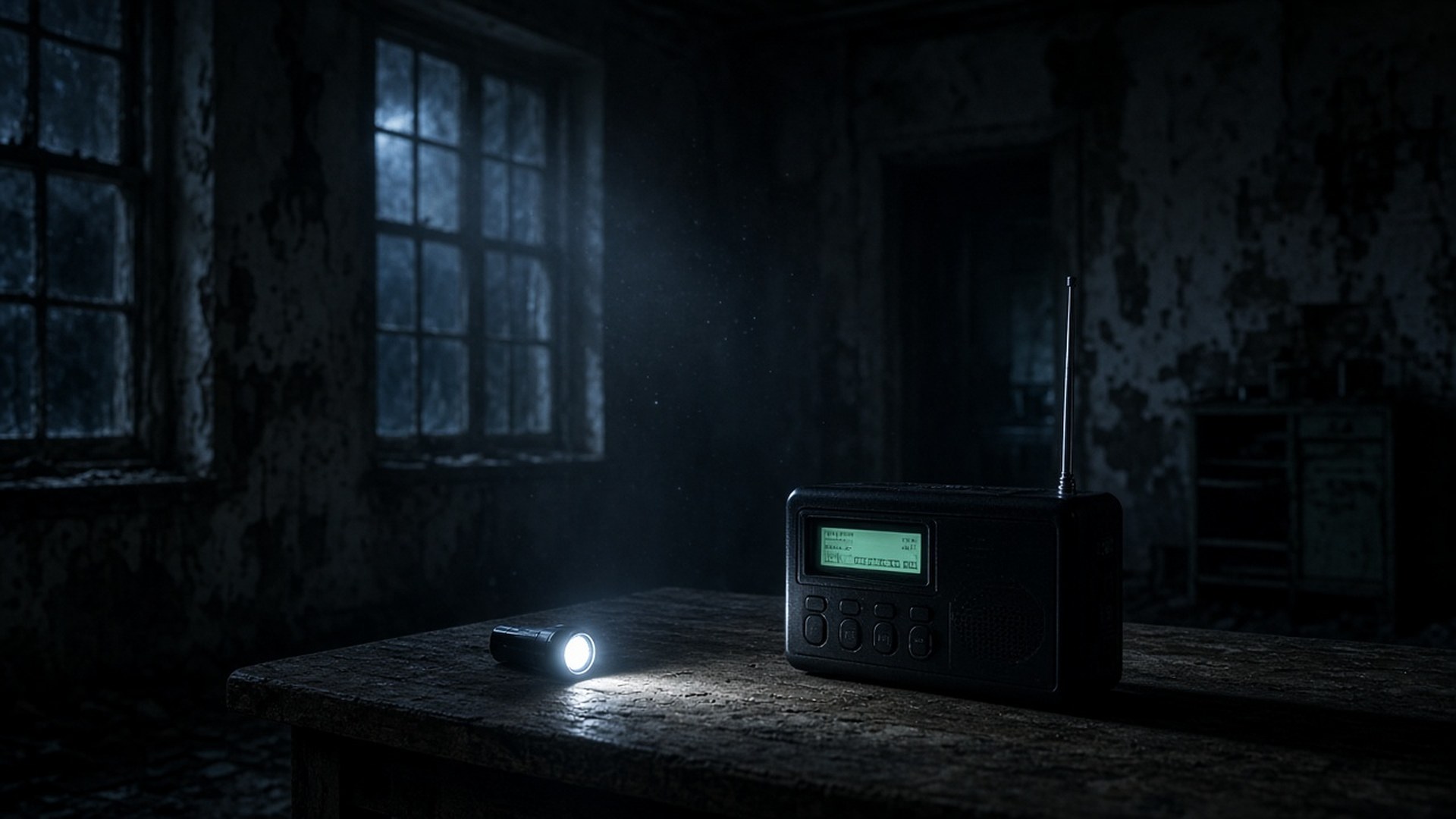
What a radio-sweep spirit box actually does, which models investigators reach for on Amazon, and how to run a session so a voice in the static is worth keeping.
As an Amazon Associate, Italian Ghost Hunters earns from qualifying purchases.
A spirit box is not a verdict, and what comes through it deserves careful listening, careful recording, and an open mind. What it does is open a channel of sound — a rapid sweep across radio frequencies, mixed with bursts of white noise — and invite the room to answer through it. Investigators have carried these handheld units into locked wards, empty ballrooms and quiet rectory cellars for years, because so many reported encounters arrive with the same accompanying detail: a word, a name, or a short reply that seems to land inside the sweep when nothing ordinary is speaking.
This is part 2 of our ghost hunting gear series. Part 1 covered EMF meters for ghost hunting; this guide is for someone choosing a first spirit box for ghost hunting to build out a communication kit. It covers what a ghost box is actually doing, three well-known spirit boxes sold on Amazon.com with published specifications you can verify yourself, and a field protocol that treats apparent replies as candidates for evidence rather than as automatic proof. Check the current price on each product page before you buy; listings move.
What a Spirit Box Is Actually Doing
A spirit box — also called a ghost box, or more precisely a radio sweep ghost box — is a radio that refuses to stay on one station. It sweeps forward or backward through AM, FM, or both, pausing on each frequency for only a fraction of a second. What you hear is a collage: fragments of broadcast speech, music, static, and the device’s own sweep noise. The working idea in instrumental transcommunication (ITC), and the reason the box is usually filed as an ITC device, is that spirits may use that stream of sound — the energy and the broken syllables — to form words that reach the living.
That is why teams treat the box as a live microphone into the unknown, not as a party trick. You ask a short question. You leave silence. You listen for something that answers the question rather than something that merely floats past on a commercial. A digital audio recorder running beside the box is not optional. Memory invents drama. A timestamped file does not.
Ordinary radio is not the enemy of that process. Mapping ordinary radio is how you keep the unexplained reply clean. In a dense city you will hear more station fragments. In a rural cellar you may hear mostly sweep and noise. Neither setting proves spirits are present or absent. Both settings demand the same discipline: know what the band sounds like before you claim a voice.
Three Spirit Boxes Worth Knowing
The models below are real Amazon.com listings with published manufacturer details. Specs here come from those pages. We have not hands-tested these units for this article. Confirm stock, seller and current price on Amazon before you order.
P-SB7 Spirit Box — the classic radio-sweep starter
The P-SB7 Spirit Box is the compact handheld many people picture when they hear “ghost box.” According to the Amazon listing (model SB7T-R5, brand GhostStop), the current revision includes AM/FM tuning, adjustable sweep speed and direction (forward and backward), a backlit display for dark rooms, a built-in flashlight, noise reduction, Bluetooth audio output alongside an auxiliary connection, and ATDD (automatic temperature deviation detection) that alerts when temperature changes by about ±5°F. The product description notes half-step frequency increments, an extra-fast sweep rate down to 50 ms, and an FM scan range described from 76 MHz to 87.9 MHz. Power is listed as battery powered; the description states three AAA batteries (not included), while some listing fields mention two — check the unit itself and the seller notes before you buy.
Why investigators like it: it is small enough for a coat pocket, readable in near-dark, and simple enough to learn in a hallway before you take it into a reputedly active floor. Why you still need discipline: a busy FM band will throw speech fragments into every session. Headphones or an external speaker help volume; a second recorder catches what your ears miss. Check the current price on Amazon.
P-SB11-ANC — dual AM/FM sweep with noise control
The P-SB11-ANC Spirit Box is sold as a deluxe SB11-class unit with adjustable noise control (ANC). According to the listing (model P-SB11-ANC), it offers dual-channel AM and FM sweep at the same time, independently adjustable sweep speed on each channel, forward or backward scanning per channel, independent volume per channel, a mute button, an antenna on/off switch, ATDD alerts for temperature changes of about 5°F from baseline, a built-in night-vision-friendly red flashlight, and dual audio output ports for recorders or speakers. Power is a 9V alkaline battery. The description states that ANC reduces unwanted scanning noise so possible messages are easier to distinguish in the stream.
For ghost hunting, the dual-band design earns its place when you want both AM and FM open in one session — a setup many investigators report as clearer for real-time replies — while ANC and antenna control help you dial back raw station pickup in a city. Dual outputs let you feed a recorder on each channel. Check the current price and what the seller includes (battery, accessories) before you buy.
PSB7 PRO — sweep control plus trigger sensors
The PSB7 PRO Spirit Box is listed as a higher-control ITC unit (model PSB7-PRO). According to the Amazon page, it offers AM/FM forward and reverse sweep, seventeen sweep speeds from 30 ms to 350 ms, adjustable frequency step length so the scan can move between stations in finer increments, a REM touch pad used with a tapping technique the maker associates with more EVP messages, REM-field and infrared trigger sensors that can keep the box silent until a sensor fires, then open a short sweep window, ATDD plus ambient temperature readout (alerts at about ±5°F), a built-in flashlight, a red-backlit display, and auxiliary audio output. The listing notes a special blend of up to forty frequencies identified as a communication “sweet spot,” a premium internal speaker, and power from three AA batteries (often listed as included with a manual).
What makes it useful on a quiet floor is the mute-and-trigger workflow: the room stays silent until something trips a sensor, then the sweep opens for a few seconds you can set. That turns a continuous noise wall into discrete windows of sound — easier to log against questions, EMF spikes and cold shifts. Check the current price on Amazon.
How to Use a Spirit Box So the Evidence Holds
Treat the first minutes on site as mapping, not hunting. Power the box, note the battery state, and listen to a short sweep with ordinary lights on. Write down how busy the band is: dense speech fragments, mostly static, or a mix. That notebook line is your radio baseline. Without it, every syllable later sounds like a miracle.
Then strip the ordinary sources you can control. Phones on airplane mode or left outside the room. Spare radios and streaming speakers off. One person asking questions at a time. If a clear word lands, do not celebrate — investigate. Ask whether a teammate’s voice bled into the headphones. Ask whether a nearby commercial just punched through. Ask the same question again after a pause. Only when a reply survives those checks do you mark time, place, temperature, who was present, sweep settings, and what else was recording.
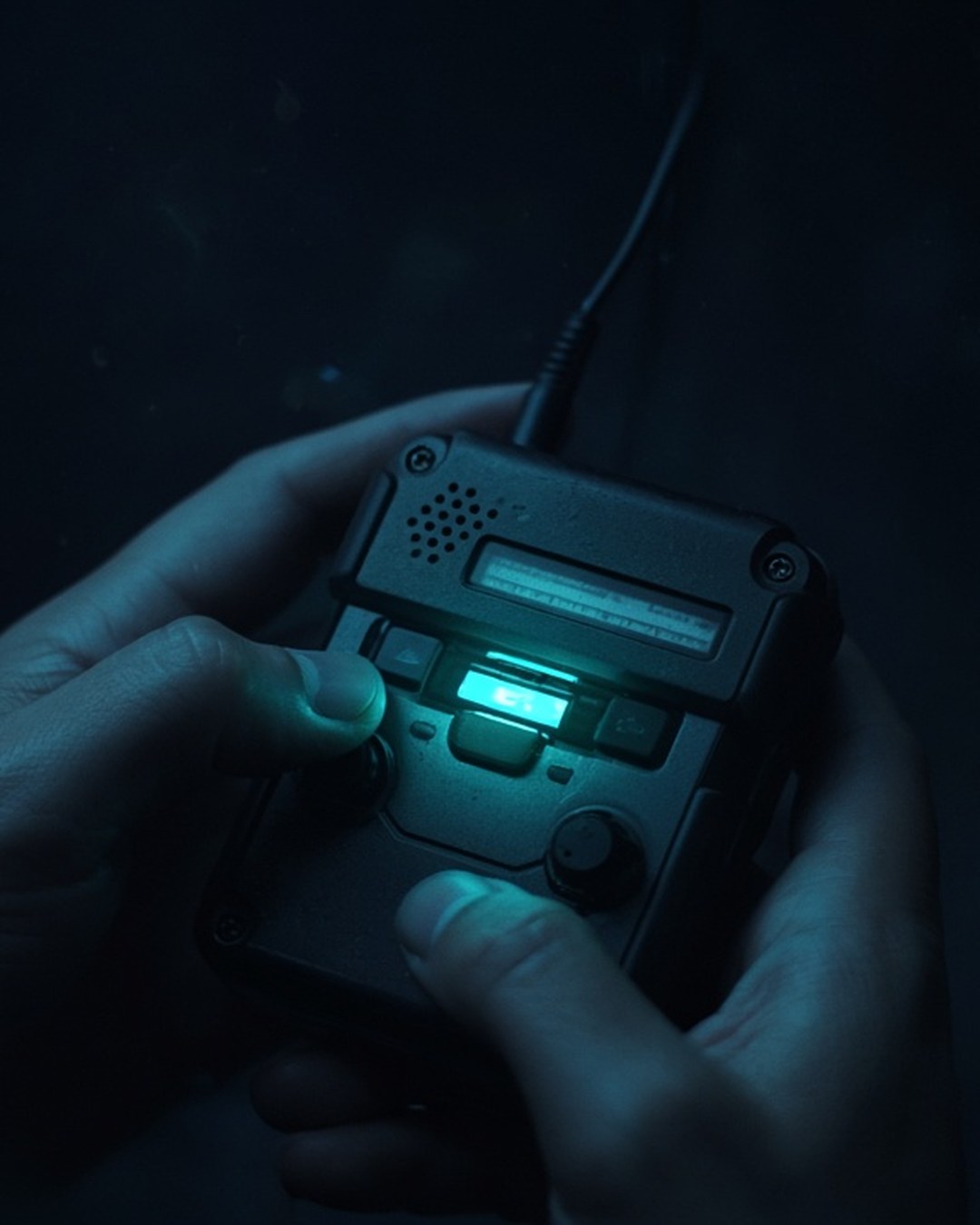
Keep questions short. Leave silence after each one. Prefer yes/no or one-word answers when you are learning the box’s voice. Film or photograph the display when settings matter. Run a dedicated audio recorder for the full session, just as you would for an EVP session, even if the box has its own output — redundancy is how files survive a dead battery. Case files like the Enfield Poltergeist are still argued over partly because so many hours of tape survive; your own recordings deserve the same care.
Many teams add a sensory-isolation protocol: one investigator wears noise-isolating headphones fed by the spirit box and a blindfold, speaking aloud every clear word they hear, while another person asks questions the listener cannot hear. The point is to reduce leading and expectation. It does not prove contact. It does make coincidence harder to stage by accident. Use it when your team is ready for a slower, more controlled hour.
The same discipline applies on ground with a heavy case file. Investigators who study Borley Rectory, or who record from a boat off Poveglia in the Venice lagoon (the island itself is closed without authorisation), face the same first task: learn what the local band sounds like before anything in the sweep is treated as a reply.
Ghost Box Interference You Should Map, Not Fear
Live radio is the first interference. In a flat city band, station IDs and ad slogans will walk through your session. Turning the antenna off (where the unit allows it), slowing the sweep, or using noise control can reduce the chaos — and can also reduce the raw material spirits are said to use. There is no free lunch. Log which settings you chose.
Electrical noise from transformers, phone chargers and walkie-talkies can colour what you hear and what your EMF meter shows beside you. Pair the box with the discipline you already use for meters: baseline the room, then strip what you can. None of that means spirits are absent from a location. It means your job is to know the building’s radio voice so a new voice stands out.
Pareidolia — hearing words in random noise because you expect them — is real and ordinary. It is why teams prefer replies that answer the question asked, that repeat on review by someone who was not in the room, and that arrive with a second instrument moving at the same moment. You are not debunking the night. You are clearing the channel so that if something answers, you can trust the file.
Building a Small Kit Around the Box
A spirit box works best beside quiet companions. An EMF meter for field spikes (see our EMF meters starter guide), a digital audio recorder, a notebook that does not rely on a glowing phone screen, spare batteries sealed in a pouch, and headphones rated for isolation if you run a blind session. If budget allows, pairing a simple starter such as the P-SB7 for walkthroughs with a dual-band or trigger-capable unit for seated vigils gives you both speed and control.
Start with one box you will actually carry. Learn its idle behaviour in your own hallway before you take it into a house like the ones in our case files on Borley Rectory or the Enfield Poltergeist — places where witnesses reported voices, knocks and presence long before anyone swept a modern radio. When you know how your box sounds next to your router and your kettle, you will recognise when a strange house is doing something else.
What Remains Open
Spirit boxes sweep radios. They do not name the speaker. Across years of investigation reports, the same pattern repeats: a quiet room, a short question, a fragment that fits the question too well, sometimes a cold shift or an EMF climb in the same breath, sometimes nothing but static and the feeling that the dark was listening. Sceptical explanations exist for many individual syllables. They do not close every file.
If you are buying your first ghost box, begin with clarity about what you want. Simple AM/FM sweep and pocket size point toward a P-SB7-style unit. Dual-band sessions with noise control and dual outputs point toward a P-SB11-ANC. Triggered mute windows and finer sweep control point toward a PSB7 PRO. Check the current price on Amazon for each, buy from a seller you trust, and spend your first night teaching the instrument the difference between a living broadcast and a mystery. The next gear guide in the series covers EVP recorders for ghost hunting.
The mystery is still out there. Your job is to arrive with a box that can tell the difference between the radio and whatever else is trying to speak through it.
Leave a Reply