
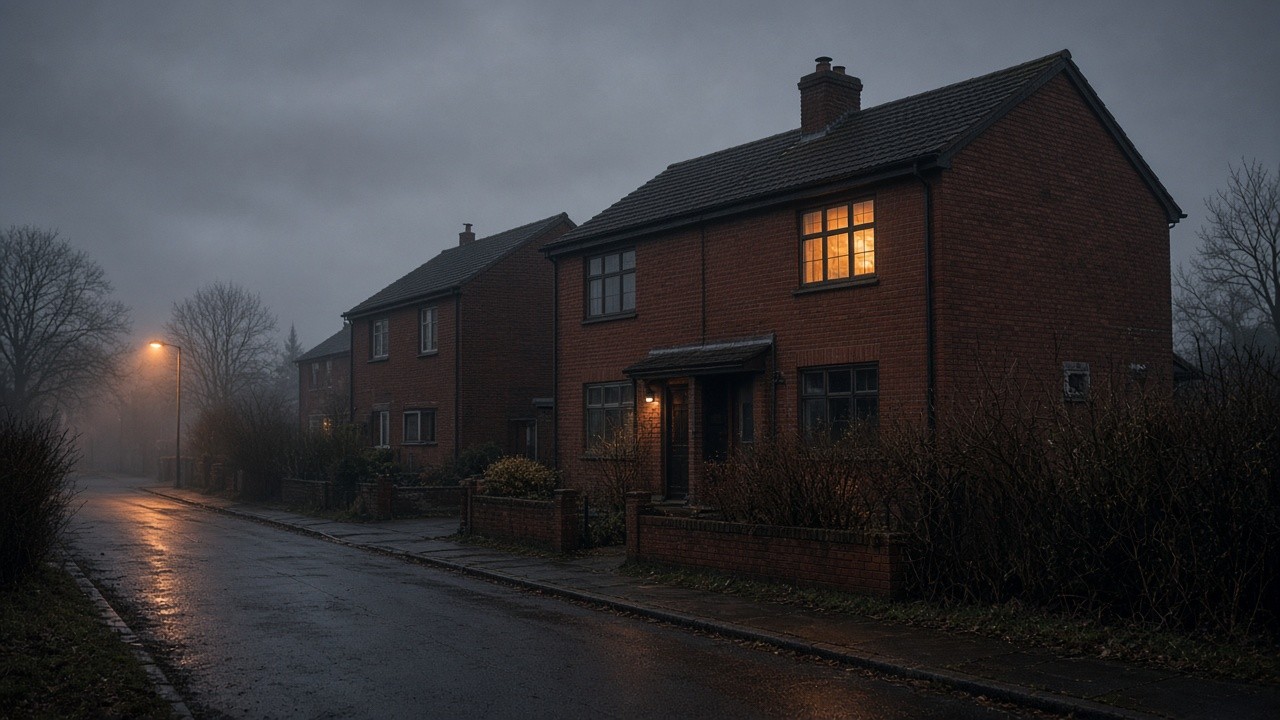
A field report from an ordinary house in West Yorkshire, where chalk dust fell from nowhere, water pooled on a dry floor, and a tall hooded figure, the family said, waited at the top of the stairs.
An Address Nobody Would Look at Twice
Most haunted houses announce themselves. They have towers, crumbling wings, family portraits that follow you down a gallery. The house at the centre of this case has none of that. It is a modest council house on a post-war estate in Pontefract, an old market town in West Yorkshire: brick walls, a small front garden, a kitchen at the back, a narrow staircase rising from the hall. On a grey afternoon it looks like every other house on the street.
That is exactly what makes the Black Monk of Pontefract so unsettling. Nothing about the place invited a ghost story. No one moved there hoping for one. And yet, by the family’s account, for months at a time in the late 1960s this ordinary home became the scene of one of the most violent and persistent poltergeist cases ever reported in Britain, the haunting now known as the Pontefract poltergeist, and the presence behind it, they came to believe, was a man in a black monk’s habit.
For investigators the case matters for another reason too. Decades after the events, the house still draws people who come to sit in its rooms at night, and many of them leave with stories of their own.
The Setting: A Town With a Long Memory
Pontefract is far older than its estates suggest. The town grew up around a great medieval castle, now a ruin, whose walls saw sieges and royal prisoners, and it was once home to a medieval priory of Cluniac monks. The Cluniacs followed the Benedictine rule and wore black habits, which is worth remembering when we come to the figure on the stairs.
Local lore adds a darker layer. A story told in the town holds that, centuries ago, a monk was hanged on or near the ground where the estate now stands, and some versions say there were once gallows close by. No record of such an execution has ever been traced, and the legend may have grown up around the haunting rather than before it. But in Pontefract it is told and retold, and for many people it is the key to everything that followed.
The First Outbreak
The trouble began in the summer of 1966, when, by the family’s account, most of the household was away and only the teenage son and his grandmother were at home.
The falling dust. The first sign was a fine white powder drifting down through the air of the living room, like chalk dust from a ceiling that showed no cracks. It settled on the furniture and on the people in the room. It seemed to fall from a point somewhere above their heads, though nothing above them could explain it.
Water on a dry floor. Then pools of water began to appear on the kitchen floor. They were mopped up and came back. The family asked the local water board to look for a leak, and the story, as they told it, is that no leak and no source were ever found.
The kitchen comes alive. Taps and switches were said to turn by themselves. A tea dispenser reportedly worked on its own, spilling tea leaves across the worktop, and green foam was said to gush from the taps. Cupboards rattled. A plant was found moved some distance from where it had stood, as if carried.
And then, almost as abruptly as it started, it stopped. For about two years the house was quiet, and the family, understandably, tried to put the whole episode behind them.
The Second Outbreak: When the Pontefract Poltergeist Turned Violent
When the activity returned, around 1968, it had changed. The playful, baffling tricks of 1966 gave way to something that felt hostile, and it seemed to centre on the daughter of the house, by then a young teenager.
Things thrown and broken. Ornaments and crockery were said to fly across rooms and smash. Lights went off. Doors slammed in empty rooms. Loud crashes and bangs came from parts of the house where no one was standing.
The staircase. The most disturbing accounts concern the girl herself. The family said she was pulled from her bed and dragged up the stairs by an unseen force, and that marks appeared on her throat afterwards. They described it plainly, as something they witnessed rather than something she reported alone.
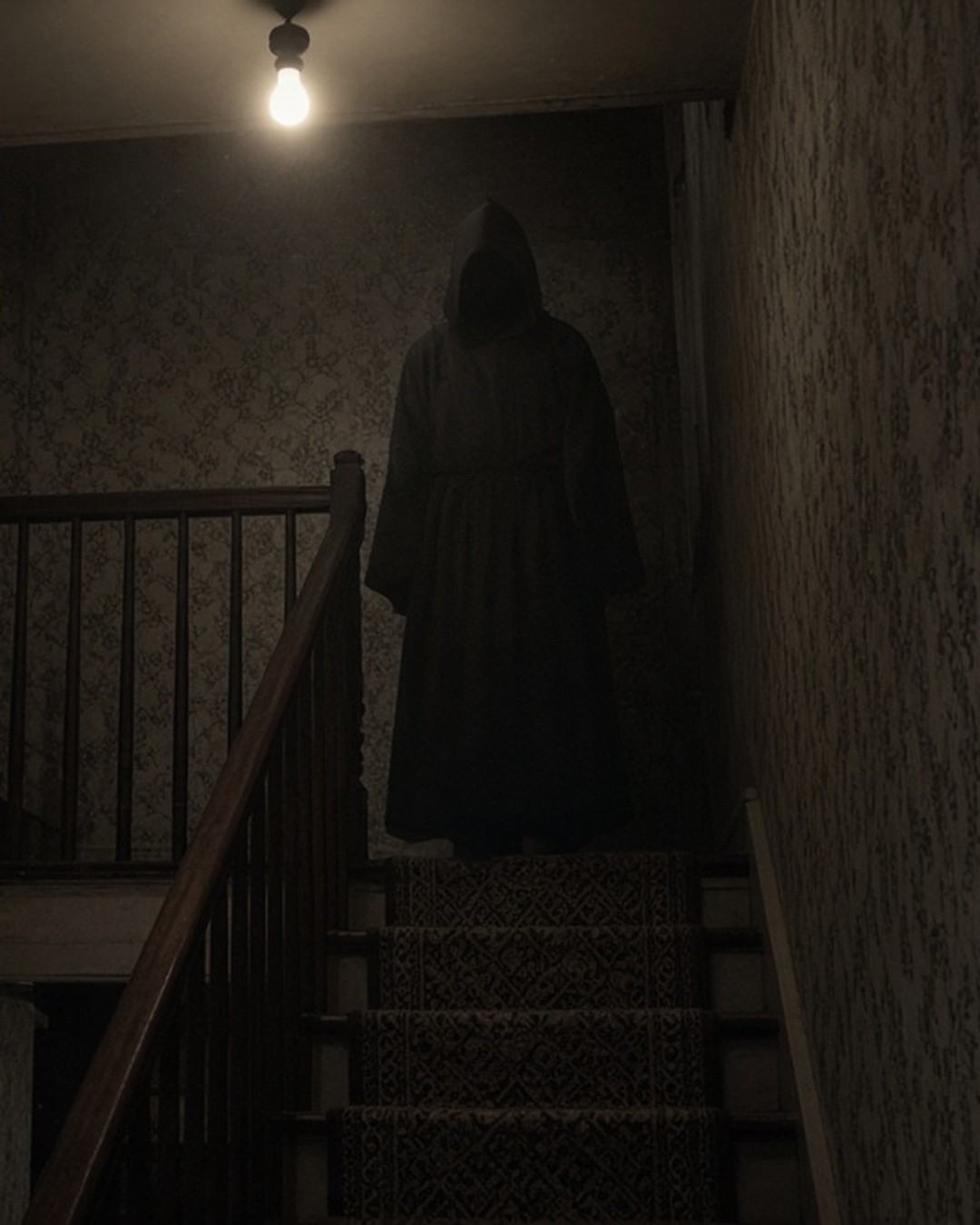
The figure. Members of the family later described seeing a tall, dark figure in a hooded black robe, like a monk’s habit, inside the house. It was seen in the hall and at the top of the stairs, standing still, and then it was gone. Its face, if it had one, was never clear.
Fred. In the way of people who have to live alongside something they cannot escape, the family gave the presence a nickname, Fred, as though naming it might make it a little less frightening. Some of the stranger moments almost read as mischief. A visiting relative who made no secret of her doubts later described a pair of gloves rising into the air and moving, as if keeping time to the hymn she was singing.
Who Investigated, and How
There was no grand laboratory investigation at Pontefract, and that is part of what makes the case so raw. The people who came were the ones a frightened family would naturally call: neighbours, relatives, the local vicar, and, by some accounts, an attempt at an exorcism. None of it, the family said, made any lasting difference.
The detailed record we have today comes largely from testimony gathered later. More than a decade after the events, a well-known writer on the paranormal interviewed the family and neighbours at length, and his account fixed the Black Monk in the literature of British poltergeist cases. Others have revisited the story since, and the house itself has passed into the hands of owners who opened it to paranormal visitors.
That history has a cost. Much of the evidence for Pontefract is recollection rather than contemporary measurement: there were no instruments running in 1966, no recordings, no chalk-marked objects of the kind used at other famous houses. What the case does have is a remarkable consistency in the core story told by several witnesses who lived through it.
What Remains Unexplained
This is the heart of the file, and it is a long list.
The dust and the water came first, before any legend of a monk had attached itself to the house, and before anyone had a reason to imagine one. They were mundane, physical, and witnessed by more than one person. A leak can be found; this one, the family insisted, never was.
The figure is harder still. Several people, at different times, described the same thing: tall, hooded, dark, silent. The black habit matches what monks of the old Pontefract priory would actually have worn. Whether that is a meaningful link to the town’s medieval past, or a coincidence that the legend later wove into itself, no one has ever settled.
Then there is the violence, the girl on the stairs, the marks on her throat. Poltergeist cases often seem to gather around a young person in the household, as they did at Enfield and in the Bavarian law office at the heart of the Rosenheim poltergeist, and some researchers see that pattern as a clue to the force behind them. Others see it simply as the shape such hauntings take. Pontefract fits the pattern and still refuses to be explained by it.
And finally there is the house itself. Long after the family’s ordeal ended, visitors who stay in it continue to report cold spots, sudden bangs, things moving, and the unnerving sense of being watched from the landing. If the activity was tied only to one family, it should have left with them. Many who have spent a night there would say it did not.
Lessons for Investigators
Pontefract is a reminder that the most important cases often happen in the least dramatic places, and that the first hours matter more than the decades that follow.
- Record it while it is happening. The case relies heavily on memory. Write down every event with the date, time, room and witnesses, as soon as it occurs.
- Rule out the plumbing properly. When water appears, document that a professional checked for a source, and photograph the floor before and after. An unexplained pool is far stronger evidence when the ordinary causes have been carefully excluded.
- Separate the legend from the evidence. Note what was seen before anyone mentioned a monk or a gallows, and what was reported afterwards.
- Look after the people first. A poltergeist case is lived by a family, often with children at its centre. Their wellbeing comes before any investigation.
- Respect the house and its neighbours. It sits on a residential street. Visit only with the owner’s permission, keep noise down, and never trespass or loiter outside other homes at night.
A Case Still Open
The Black Monk of Pontefract has none of the trappings of a classic haunting, and perhaps that is why it lingers. It happened in a kitchen and on a staircase, to an ordinary family who wanted nothing more than for it to stop. They gave it a name, they asked for help, and in the end they simply waited for it to go.
Did a monk hanged centuries ago find his way into a council house built on the ground where he died? Or did something with no name at all borrow his shape? Those who lived there never claimed to know. Stand in that narrow hall at night, look up at the dark landing, and you may find you do not want to know either.
For more cases that refused to close, read our case files on the Enfield Poltergeist, Borley Rectory and the knocking spirit of Epworth Rectory.
Leave a Reply