
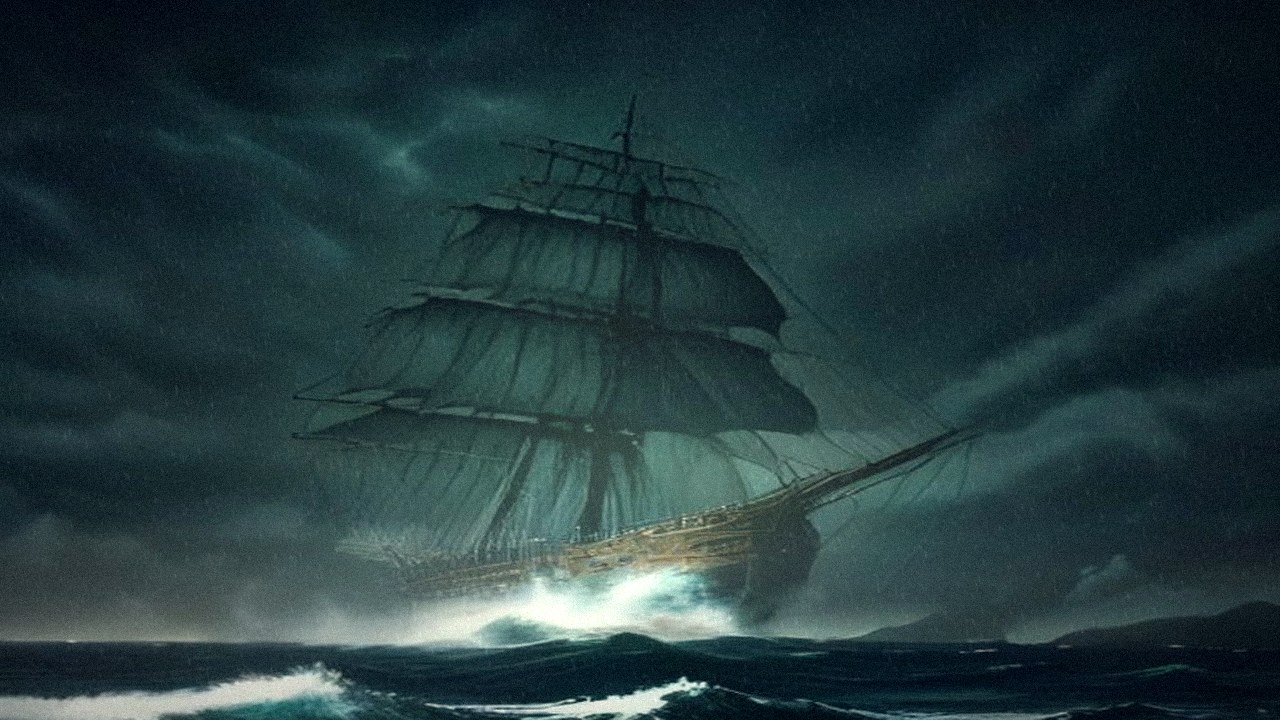
A field report on the most famous phantom ship of the sea: a captain who swore an oath against the storm, a crew that can never come home, and a glowing hull still reported off the Cape of Good Hope.
This article contains affiliate links; Italian Ghost Hunters may earn a commission if you buy through them.
Most ghosts are bound to a house, a road or a room. The Flying Dutchman ghost ship is bound to the whole ocean. For more than two centuries, sailors rounding the southern tip of Africa have spoken of a ship that should not be there: an old-fashioned vessel under full sail, beating into a gale that would have torn any real ship apart, sometimes glowing with a pale light of its own. She never answers a hail. She never reaches harbour. And the men who see her have long believed that the sighting means something, usually something bad. For investigators of the supernatural, she is the purest case of an omen that travels.
Like the banshee who cries outside an Irish door before bad news arrives, the Dutchman belongs to the old family of warning spirits. The difference is that her warning comes out of the dark at sea, where there is nowhere to run.
The Legend as It Is Told
The heart of the story is simple and terrible. A Dutch captain, homeward bound from the East Indies, tries to round the Cape of Good Hope in the teeth of a ferocious storm. His crew begs him to turn back and shelter. He refuses. In the most common telling he swears, with a terrible oath, that he will round the Cape if it takes him until the end of time.
He is taken at his word. The ship never makes it round, and never sinks either. From that night on, captain and crew are condemned to sail the waters off the Cape forever, fighting the same storm, unable to land, unable to die.
The details sailors added over the years are what make the tale so unsettling. The phantom ship is said to appear in heavy weather, often at night or in the grey hour before dawn. She comes on against the wind, her sails full when no wind could fill them. Some witnesses describe her as dark and battered, others as glowing with a cold, reddish or greenish light, as if the hull were lit from within. When she draws close, she may seem to try to signal, or to lower a boat. Then she is gone, and the sea where she sailed is empty.
Regional Variants and the Captain’s Many Names
The captain’s name changes depending on who is telling the story. Some versions call him Van der Decken, others Van Straaten. A few tie the legend to a real seventeenth-century Dutch skipper famous for making impossibly fast passages to the East Indies, so fast that people whispered he must have made a bargain with the devil to manage it.
The sin that damned him changes too. In one version he gambles with the devil at dice and loses his soul. In another he blasphemes against heaven in the storm. In a darker variant, a terrible sickness breaks out on board, and every port turns the ship away for fear of infection, until the crew is left to wander the sea with no harbour willing to take them. In each version the punishment is the same: a voyage without end.
The most haunting variant of all concerns letters. In this telling, the phantom ship draws alongside a living vessel and her crew calls out, begging the sailors to carry letters home. The letters are addressed to wives, children and friends in the Netherlands. But the names on them belong to people who died long ago, and the streets they name have long since changed. To accept the bundle, old sailors said, was to share the curse, and any ship that took the letters aboard would never reach port herself.
Historical and Cultural Roots
The legend grew out of a real and dangerous sea. The waters around the Cape of Good Hope were the great crossroads of the age of sail. Every ship sailing between Europe and the East Indies had to pass that way, and the Cape earned a fearsome reputation for sudden gales, mountainous seas and rocky coasts that wrecked ships and drowned crews. For the Dutch East India merchants, it was both the gateway to fortune and a graveyard. A story about a ship that tried to defy that sea and lost forever was bound to take root among the men who had to sail it.
By the end of the eighteenth century, travellers returning from the Cape were already recording that sailors spoke of a phantom Dutch ship seen in those waters in bad weather. In the early nineteenth century, magazines and writers took the tale up, and an 1821 magazine story helped fix the image of the doomed ship that tries to send its letters home. From there the legend sailed into poems, plays, novels and music across Europe, and the name of the Flying Dutchman became known to people who had never seen the sea.
Strictly speaking, sailors used the name for the ship rather than the man, and the two have blurred over time. Either way, the phrase came to mean anything doomed to wander without rest.
How Belief Shaped Life at Sea, and the Other Famous Ghost Ships
At sea, belief was never a matter of entertainment. Sailors lived by omens because their lives depended on reading the sky and the water correctly, and the Dutchman became one of the strongest omens of all. To see her was widely taken as a sign that the ship would be wrecked or that someone aboard would not live to see home.
That fear shaped behaviour in quiet ways. Crews were reluctant to speak of the ship at all on watch. Some refused to answer a hail from an unknown vessel in heavy weather off the Cape. The tale of the letters became a rule of thumb: whatever comes alongside in the storm and begs a favour, give it nothing and take nothing aboard. Superstitions like these travelled from ship to ship and port to port, carried in the same way as the legend itself.
Sailors in other waters had their own phantom ships, and they spoke of them with the same seriousness. Off the Chiloé archipelago in southern Chile, people tell of the Caleuche, a glowing ghost ship that sails through the night with music and laughter drifting from its decks, crewed by the drowned, able to vanish beneath the waves. In the Baie des Chaleurs between New Brunswick and the Gaspé coast of Canada, generations have described a burning ship seen on the water, often before a storm. Off the coast of Kent, the legend of a ship wrecked on the Goodwin Sands says she returns to the sandbanks on the anniversary of her loss. Off Rhode Island, Block Island has its own burning ghost ship, the Palatine light, tied to an eighteenth-century emigrant voyage. The sea, it seems, keeps its dead close, and even an enclosed lagoon can hold its ghosts, as the haunted island of Poveglia in the Venice lagoon shows.
Flying Dutchman Sightings Told as Real Encounters
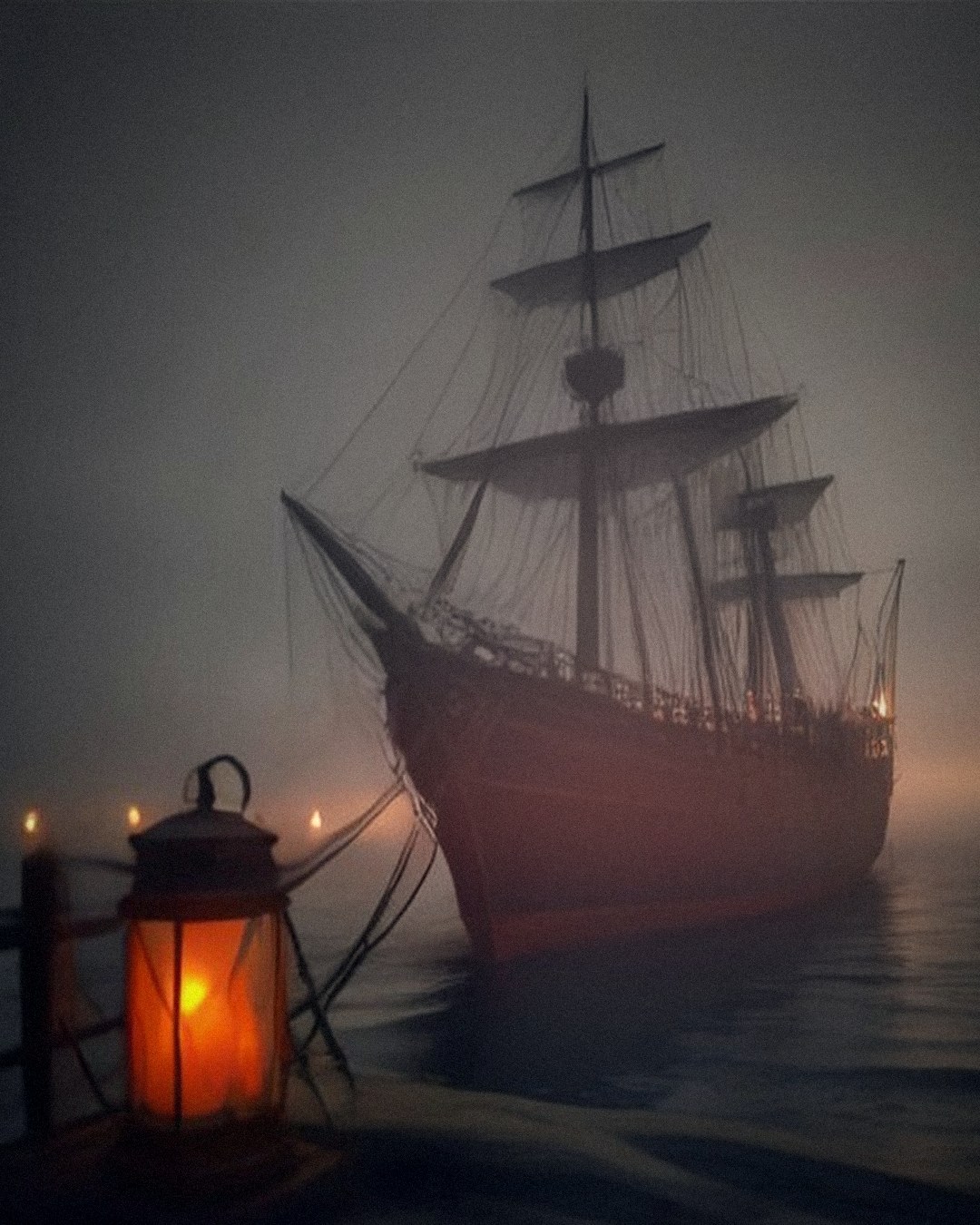
What sets the Flying Dutchman apart from most sea legends is the number of people who have reported seeing her, and the sober way many of them told it.
The royal training cruise, 1881. The best known account comes from a long naval training voyage made in 1881 by a warship carrying two young princes as midshipmen. Off the south-eastern coast of Australia, in the small hours of a July morning, the journal kept on that voyage records that the phantom ship crossed their bows. She was described as glowing with a strange red light, as if every part of her were lit, her masts, spars and sails standing out clearly. A number of men on watch saw her, and then she was gone, with nothing left on the horizon. The same journal notes that the sailor who first reported the sighting fell from the rigging later that day and was killed. For those who believed in the omen, no further proof was needed.
The beach at Glencairn, 1939. On the shores of False Bay, near the Cape itself, a crowd of beachgoers at Glencairn reported watching a sailing ship of an old-fashioned design moving across the bay under full sail on a day with no wind to speak of. By the accounts of the time, she held her course in the calm as if driven by a gale nobody else could feel, and then she vanished before the eyes of the people watching from the sand.
The warning in the fog. Beyond these famous cases, the sightings tend to rhyme. A watchman at the rail in the grey before dawn sees an old ship where no ship should be, closing fast against the wind. A crew in heavy weather off the Cape reports a hull glowing faintly in the dark. Lights are seen where the charts show only open water. Many witnesses were experienced seamen who knew every kind of ship afloat and said plainly that this one was not of their century.
Some modern writers reach for an explanation in the strange optics of the sea: a rare kind of mirage that can lift and stretch the image of a distant ship above the horizon. It is one view among several. It does not tell us why so many witnesses describe the same old-fashioned ship, the same glow, the same course into the wind, or why the stories so often end in loss.
Why the Legend Endures
The Flying Dutchman endures because the sea has never stopped being vast, dark and indifferent. Even now, a ship far from land at night is a small island of light in an enormous emptiness, and the Cape still throws up the same storms it always did. Anyone who has stood a night watch knows how easily the dark can fill with shapes.
She endures, too, because her curse is one everybody understands. The captain’s crime was pride: he set his will against the storm and swore he would not give way. His punishment is the one thing a sailor fears most, to be cut off from home forever, always in sight of the voyage’s end and never allowed to reach it. In that sense the Dutchman is less a single ghost than the restless dead of every voyage that never came back.
Like the great black hound of Black Shuck on the East Anglian coast road, she is a spirit of the lonely journey, appearing to the traveller at the moment when they feel most alone. And like La Llorona, who walks the water’s edge forever searching for what she lost, the Dutchman is a soul tied to the water by a single terrible choice. Closer to home, the Neapolitan house spirit Il Munaciello shows how every coast and city shapes its own folklore of restless souls.
If You Are Watching the Water
For investigators who want to look for the Dutchman themselves, the sea demands more respect than any haunted house.
- Watch from safe, public places: headlands, beaches and harbour walls, never cliff edges or closed paths.
- Note the date, time, weather, wind direction and sea state for every observation. Phantom ships are reported against the wind, so the wind matters.
- Record what you see in plain words before you discuss it with anyone, so that your memory stays your own.
- Photograph or film steadily, and keep the horizon line in shot so the position of anything you capture can be judged later.
- Talk to local fishermen and harbour workers with courtesy. Many coastal communities have their own phantom ships, and the best testimony is often never written down.
- Never go out on the water at night or in bad weather to chase a sighting. The legend is a warning, and it is wise to take it as one.
The Voyage Without End
Strip away the opera stages and the storybooks and the Flying Dutchman is something very old: the memory of every ship that left harbour and never returned, and of the families who waited for letters that never came. The Cape of Good Hope swallowed many such ships, and the sailors who passed it after them gave those lost crews a face and a name.
But the file does not close there. The sightings kept coming long after the age of sail ended, from naval watchmen, from fishermen, from crowds on the beach. Nobody has ever fully explained what they saw. Somewhere off the Cape tonight, the wind is rising and the sea is running high, and if the old sailors were right, a captain who swore an oath against the storm is still trying to round the point, his lights glowing faintly through the spray, waiting for someone to take his letters home.
If the doomed ship off the Cape has you thinking about turning legends like this into your own ghost mystery novel, Ghost Mystery Writer is a downloadable library of 456 prompts for writing complete ghost mystery novels with a free AI chat assistant, built for people who self-publish on Amazon.
Leave a Reply